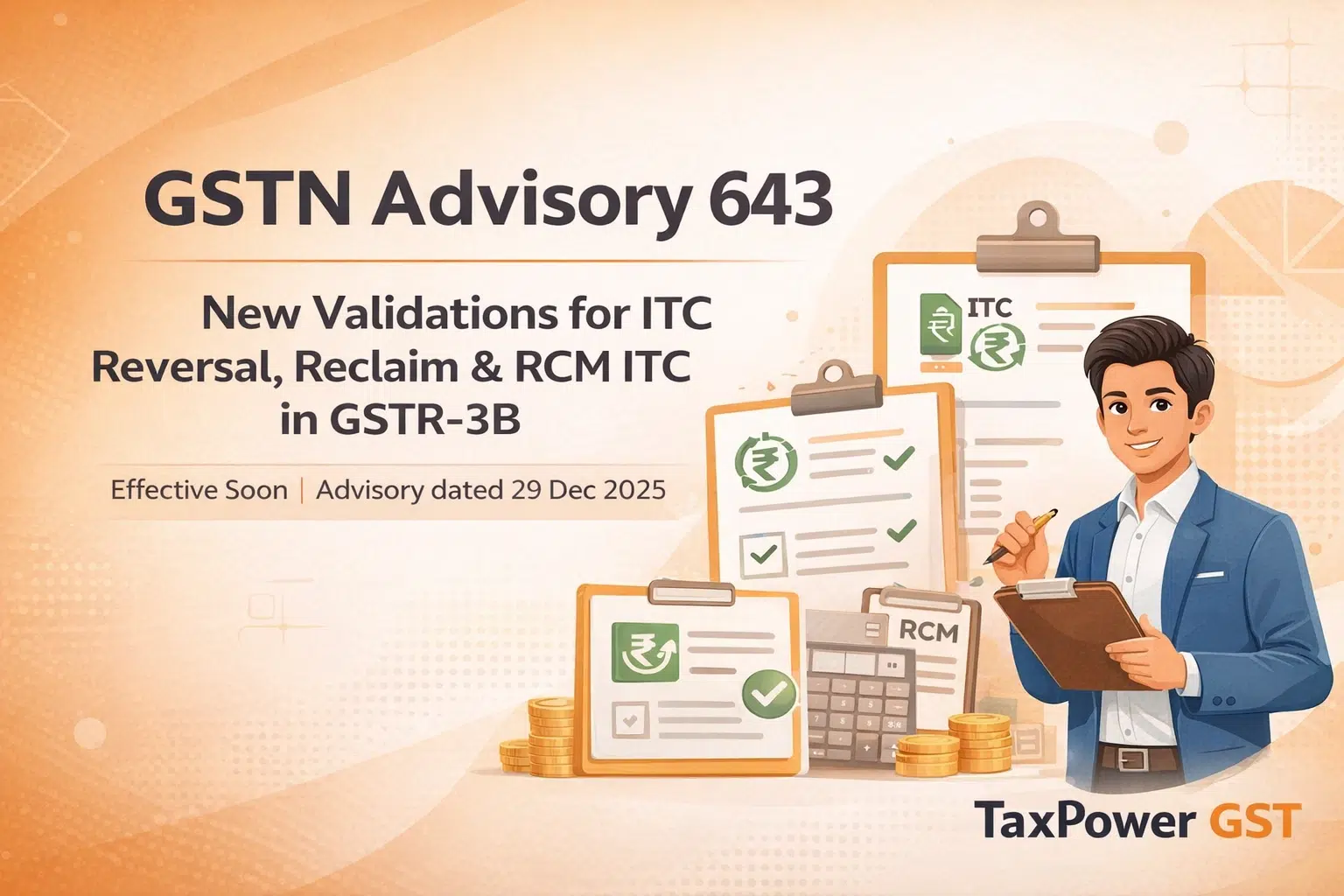
GSTN Advisory 643: Electronic Credit Reversal (Reclaim Ledger) & RCM Liability/ITC Statement – New GSTR-3B Validations Explained
On 29th December 2025, GSTN issued Advisory No. 643 along with FAQs to strengthen system controls for ITC reversal & reclaim and RCM liability/ITC reporting in GSTR-3B. The key message is clear: soon, negative balances and excess ITC availment beyond ledger limits will not be allowed, and in certain cases GSTR-3B filing will be blocked until corrections are made. (Source: GSTN Advisory 643)
This blog explains each advisory point first and then a practical, step-by-step explanation below it, so CAs, GST practitioners, and finance teams can implement the changes smoothly using TaxPower GST software.
Table of Contents
1) What is the Electronic Credit Reversal & Re-claimed Statement (ITC Reclaim Ledger)?
Advisory:
To ensure correct reporting of reversed and reclaimed ITC, the Electronic Credit Reversal and Re-claimed Statement (Reclaim Ledger) was introduced on the GST portal from Aug 2023 (monthly) and Jul–Sep 2023 (quarterly). It captures ITC reversed in Table 4(B)(2) and subsequent reclaim in Table 4(A)(5) and Table 4(D)(1).
Explanation (What it means for you):
This ledger works like a running balance of ITC that was temporarily reversed earlier and can be reclaimed later. Practically, it reduces clerical errors by ensuring that reclaim is linked to earlier reversals instead of being done purely on manual working papers.
Where it impacts filing: Your ITC reclaim in Table 4(D)(1) will soon be validated against this ledger’s balance (with additional rules described below).
2) Current Situation: Warning Message for Excess Reclaim Still Allows Filing
Advisory:
As of now, if a taxpayer attempts to reclaim excess ITC in Table 4(D)(1) beyond the available ITC reversal balance, a warning appears, but the taxpayer is still allowed to file GSTR-3B.
Explanation (Why this is changing):
Many taxpayers ignored the warning and filed returns, resulting in negative ledger balances and future compliance issues. GSTN Advisory 643 indicates the portal will soon move from “warning-only” to hard validation / blocking to stop excess reclaim at filing stage.
3) Opening Balance Opportunities in ITC Reclaim Ledger (Transition Relief)
Advisory:
Taxpayers were provided multiple opportunities to report their opening balance (ITC reversed earlier but not reclaimed) for the newly introduced Reclaim Ledger.
Explanation (What you should understand):
When the Reclaim Ledger started, GSTN recognized that taxpayers had legacy reversals from earlier periods (before the ledger existed). To avoid genuine ITC getting stuck, GSTN allowed taxpayers to declare such unreclaimed reversals as opening balance so the ledger reflects reality.
Common situations where opening balance mattered:
- ITC reversed earlier due to vendor payment delays / internal controls
- Reversals done due to mismatch resolution and later eligible for reclaim
- Historical reversals not captured in the Reclaim Ledger’s initial periods
Why this point is critical now: Advisory 643 indicates the system is shifting to strict ledger-based regulation. If your opening balance was not reported correctly earlier, future reclaim may fail validation or cause negative balances that can block filing.
4) How to View the ITC Reclaim Ledger on GST Portal
Advisory:
This statement can be viewed by navigating to: Dashboard → Services → Ledger → Electronic Credit Reversal and Re-claimed.
Explanation (Best practice):
Before filing every GSTR-3B, check the Reclaim Ledger and verify that your intended reclaim in Table 4(D)(1) is within allowable limits. This is especially important for clients who frequently reverse and reclaim ITC across periods.
5) What is the RCM Liability/ITC Statement (RCM Ledger)?
Advisory:
To assist taxpayers in correctly reporting RCM transactions, the RCM Liability/ITC Statement was introduced from Aug 2024 (monthly) and Jul–Sep 2024 (quarterly). It tracks RCM liability in Table 3.1(d) and corresponding ITC in Table 4(A)(2) and 4(A)(3) for each period.
Explanation (Practical meaning):
RCM ITC should align with RCM tax paid. This ledger ensures you don’t claim RCM ITC beyond what is paid/available. For professionals, it becomes a quick audit trail: RCM liability paid vs RCM ITC claimed.
6) Warning Message for Excess RCM ITC Claim (Current Scenario)
Advisory:
A warning message appears if ITC claimed in Table 4(A)(2) and 4(A)(3) exceeds the closing balance of the RCM ledger plus the liabilities being reported in Table 3.1(d).
Explanation:
Today, the system warns you. Soon, this will likely become a filing restriction as per Advisory 643’s enforcement direction. If your client has complex RCM transactions, reconciling this ledger becomes mandatory, not optional.
7) Opening Balance & Amendment Opportunities for Both Ledgers (ITC Reclaim + RCM Ledger)
Advisory:
Taxpayers were given multiple opportunities to report and amend the opening balance in both statements where transactions relating to excess ITC reversal/reclaim or excess RCM liability/ITC prior to implementation could be declared as opening balance.
Explanation (Why GSTN provided this):
Both ledgers were introduced after GST had already been running for years. Many taxpayers had historical reversals/reclaims and RCM claims that were not ledger-tracked earlier. GSTN therefore provided correction opportunities so that taxpayers can bring historical data into the ledger framework.
What you should do now (action checklist):
- Check if opening balances for both ledgers were declared correctly for old periods
- If mismatches exist, adjust in the manner permitted by portal functionality
- Ensure that current-period entries don’t create negative balances
Key takeaway: Advisory 643 indicates the portal will soon enforce strict validation; therefore, unresolved opening balance issues can directly lead to blocked GSTR-3B filing.
8) How to View the RCM Liability/ITC Statement on GST Portal
Advisory:
RCM Liability/ITC Statement can be accessed via: Services → Ledger → RCM Liability/ITC Statement.
Explanation:
Make this a monthly/quarterly pre-filing step. If your client frequently claims RCM ITC, ledger review avoids last-minute filing blocks and reduces scrutiny risk.
9) New “No Negative / No Excess ITC” Validations Coming Soon (Key Enforcement Change)
Advisory:
Soon, negative values or availment of excess ITC beyond available balance will not be allowed in both ledgers. Validations include:
(a) ITC Reclaim (Table 4(D)(1)): Reclaim ≤ Closing balance of Reclaim Ledger + Current period reversal in Table 4(B)(2)
(b) RCM ITC (Table 4(A)(2)/(3)): RCM ITC ≤ RCM liability paid in Table 3.1(d) + Closing balance of RCM Ledger
Explanation (Simple interpretation):
| Area | What will be checked while filing GSTR-3B | If you exceed limit |
|---|---|---|
| ITC Reclaim (4D(1)) | Your reclaim must be within (Reclaim Ledger closing + current reversal in 4B(2)) | Filing may be blocked / adjustment required |
| RCM ITC (4A(2)/(3)) | Your RCM ITC must be within (RCM paid in 3.1(d) + RCM ledger closing) | Filing may be blocked / pay more RCM or reduce ITC |

GSTN Portal – Ledger balance view highlighting Electronic Credit Reversal and Re-claimed Statement (ITC Reclaim Ledger) and RCM Liability/ITC Statement as referred in GSTN Advisory 643
10) If You Already Have Negative Closing Balance: GSTR-3B Filing Will Be Blocked Until Correction
Advisory:
If a taxpayer already has negative closing balance in either ledger, the system will not allow filing GSTR-3B until corrective action is taken:
- ITC Reclaim Ledger negative: Reverse excess claimed ITC in Table 4(B)(2). If current ITC is not available, the reversal will be added to liability.
- RCM Ledger negative: Pay additional RCM liability in Table 3.1(d) OR reduce ITC claimed in Table 4(A)(2)/(3) to permissible extent.
Explanation (Practical filing impact):
This is the most important operational change. If clients have negative balances from past filings, they must correct them before filing the current return—otherwise the portal can stop filing completely. Plan corrections early (not on due date).
11) Official Reference Links Shared by GSTN
For detailed official guidance, GSTN has shared reference advisories:12) How TaxPower GST Helps You Avoid GSTR-3B Filing Blocks
- Pre-filing checks for ITC reclaim limits (4D(1) vs ledger) and RCM ITC limits (4A(2)/(3) vs ledger)
- Client-wise tracking of negative balances and corrective actions needed
- Compliance workflow for Table 4(B)(2) reversals and RCM payment/ITC alignment
- Practitioner-friendly review before final GSTR-3B filing to reduce audit/scrutiny risk
Conclusion: GSTN Advisory 643 is a clear move from “warnings” to system-enforced validations for ITC reclaim and RCM ITC. If you haven’t reconciled the ITC Reclaim Ledger and RCM Liability/ITC Statement yet, do it before the next filing cycle to avoid return filing blocks.
FAQs (GSTN Advisory 643) – Electronic Credit Reversal/Re-claim & RCM Liability/ITC Statement
Disclaimer:
This blog is intended for informational purposes only and should not be considered legal or financial advice. Readers are encouraged to independently verify all applicable Indirect Taxes Acts, Rules, Notifications, GST Council resolutions, GST laws, regulations, CBIC advisories/circulars, GSTN guidelines, E-Way Bill and e-Invoice rules, and relevant judicial pronouncements before making decisions. The author and publisher are not responsible for any actions taken based on the information provided here.
Last Updated: 29 December 2025