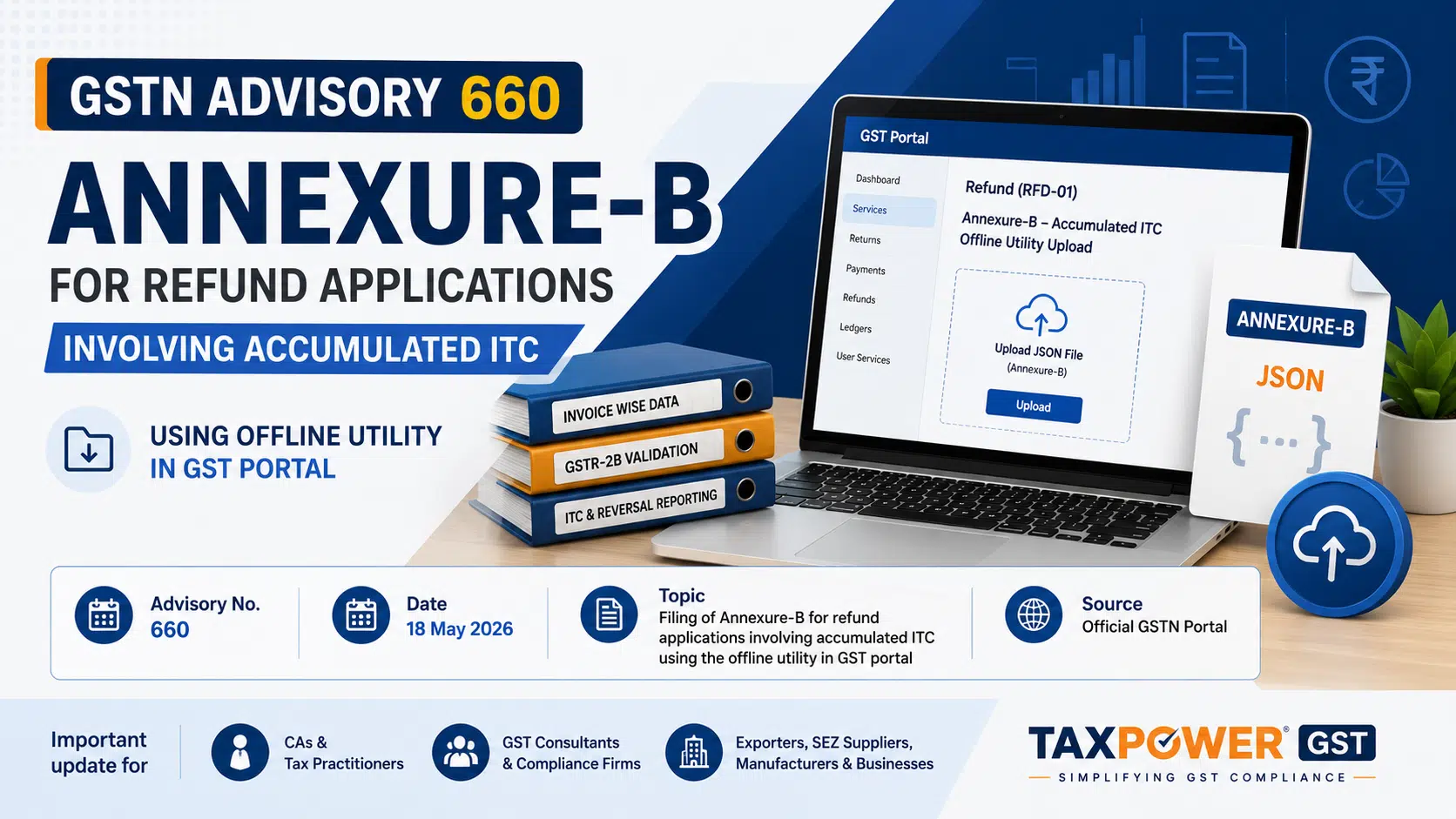
GSTN Advisory 660 dated 18 May 2026 explains the filing of Annexure-B for refund applications involving accumulated ITC using the offline utility in GST portal.
This update is important for exporters, SEZ suppliers, businesses claiming refund due to inverted tax structure, CAs, GST practitioners, refund consultants and finance teams handling Form GST RFD-01 refund applications.
Earlier, Annexure-B was generally uploaded as a PDF for specified refund categories involving accumulated ITC. As per the advisory, GSTN has now deployed a standardized Annexure-B offline utility to enable structured invoice-wise reporting and system-based verification of invoices and documents.
In practical terms, refund preparation will now require more discipline in invoice-level data, HSN/SAC-wise reporting, GSTR-2B reconciliation, ITC eligibility review and reversal reporting.
Quick Answer: What is Annexure-B for refund applications?
Annexure-B for refund applications is an invoice-wise statement required for specified GST refund applications involving accumulated Input Tax Credit.
Under GSTN Advisory 660, Annexure-B has to be prepared using the prescribed offline utility in GST portal for specified refund categories. After entering invoice-level, HSN/SAC-wise and ITC-related details, the utility generates a JSON file which is uploaded on the Form GST RFD-01 screen.
The uploaded data is validated by the portal, including validation with GSTR-2B wherever applicable.
In This Article / Table of Content
- What Has Changed in GSTN Advisory 660?
- Which Refund Categories Are Affected?
- What Details Are Required in Annexure-B?
- GSTR-2B Validation and Invalid Document Report
- ITC Reversal Reporting
- JSON Upload and File Limits
- Practical Checklist for Taxpayers and Professionals
- TaxPower GST Update / Product Readiness
- What CAs and Refund Professionals Should Do Now
- FAQs on GSTN Advisory 660 and Annexure-B Offline Utility
- Final Note / Disclaimer
What Has Changed in GSTN Advisory 660?
The key change is that Annexure-B for specified accumulated ITC refund categories is now required to be prepared through the prescribed offline utility and uploaded in JSON format.
This is a shift from a document-style annexure to a structured data upload. The objective is to bring uniformity, reduce manual handling and enable system-based invoice verification in refund applications.
For taxpayers and professionals, filing of Annexure-B for refund applications involving accumulated ITC can no longer be treated as a simple attachment exercise. The data must be properly classified, validated and reconciled before upload.
Which Refund Categories Are Affected?
The Annexure-B offline utility applies to the following refund categories involving accumulated ITC:
- Exports of goods or services without payment of tax involving accumulated ITC, excluding electricity
- Supplies to SEZ unit or SEZ developer without payment of tax
- ITC accumulated due to inverted tax structure
- Export of electricity without payment of tax
This makes the advisory especially relevant for exporters, SEZ suppliers, manufacturers, traders, large businesses and professionals handling refund applications for multiple clients.
What Details Are Required in Annexure-B?
The utility requires invoice-wise details of inward supplies for which refund is claimed. The reporting is more detailed because information has to be captured HSN/SAC-wise and category-wise.
Key details may include:
- Supplier GSTIN
- Invoice number
- Invoice date
- Category of input supply
- HSN/SAC
- Taxable value
- Tax amount
- Eligible ITC
- Blocked ITC / ineligible ITC
- ITC reversal details
- GSTR-2B period, wherever required
A major practical point is invoice splitting. If one invoice contains multiple HSN/SAC codes or different supply categories, separate line items may be required. Each line item should represent the relevant HSN/SAC and input supply category, with proportionate values and tax amounts.
Duplicate document validation is also important. The portal applies duplicate validation based on supplier GSTIN, invoice number, invoice date, category of input supply and HSN/SAC. For the same invoice, multiple lines should be reported only where the HSN/SAC or the category of input supply is different. Repeating multiple entries with identical parameters may be rejected by the system.
GSTR-2B Validation and Invalid Document Report
After upload, invoices entered in Annexure-B are validated with GSTR-2B wherever applicable.
For invoices relating to GSTR-2B periods up to October 2024 or earlier, validation with GSTR-2B data may not be carried out. This should be understood as expected system behaviour and not automatically treated as an error.
For invoices pertaining to November 2024 or later periods, mismatches or validation issues may be reflected in the Invalid Documents Report after upload. Taxpayers and professionals should review both valid and invalid document reports carefully before proceeding further.
Practical reconciliation flow
Purchase Register → GSTR-2B → ITC Eligibility → Reversal / Ineligible ITC → Refund Claim
This step is especially important where refund claims involve high invoice volume, old invoices, import documents, credit notes, debit notes, blocked credit or multiple GSTINs.
ITC Reversal Reporting
The advisory also makes ITC reversal reporting important in the Annexure-B workflow.
Reversal details may relate to Rules 38, 42 and 43 of the CGST Rules, Section 17(5), and other reversals reflected in GSTR-3B. Where multiple utility files are used, reversal amounts should be reported carefully as per the advisory instructions, especially where reversal details are required only in the final utility file.
Important: Reversal reporting can affect the refund working and the consolidated Net ITC calculation. Therefore, reversal values should be reviewed before final submission.
JSON Upload and File Limits
After completing the Annexure-B offline utility, the taxpayer has to generate the JSON file and upload it on the RFD-01 screen.
Important precautions
- Do not edit the generated JSON file manually.
- Do not change the JSON file name after generation.
- If any correction is required, make the change in the offline utility and generate a fresh JSON file.
- Use the latest version of the offline utility from the GST portal.
- Avoid using old utility versions while preparing the new file.
The current system allows up to 10,000 line items per offline utility file. A refund application can include up to 25 files, which means up to 2,50,000 line items through the utility.
If the number of line items exceeds this limit, the remaining invoices may need to be submitted as supporting documents in PDF format, as per the portal guidance.
Practical Checklist for Taxpayers and Professionals
Before uploading Annexure-B, check the following:
- Use the latest Annexure-B offline utility from the GST portal.
- Reconcile purchase register with GSTR-2B.
- Verify supplier GSTIN, invoice number and invoice date.
- Classify input supply category correctly.
- Check HSN/SAC-wise breakup.
- Split invoices where multiple HSN/SAC codes or supply categories are involved.
- Verify eligible ITC, blocked ITC, ineligible ITC and reversal amounts.
- Avoid leading, trailing or unnecessary spaces while copy-pasting data.
- Do not paste values into protected or frozen fields.
- Do not edit or rename the generated JSON file.
- Review valid and invalid document reports after upload.
- Check the consolidated summary before final submission.
This checklist is useful for CA offices, GST consultants and businesses handling refund applications regularly.
TaxPower GST Update / Product Readiness
TaxPower GST has updated the relevant functionality to support users with the Annexure-B offline utility-related process introduced through GSTN Advisory 660.
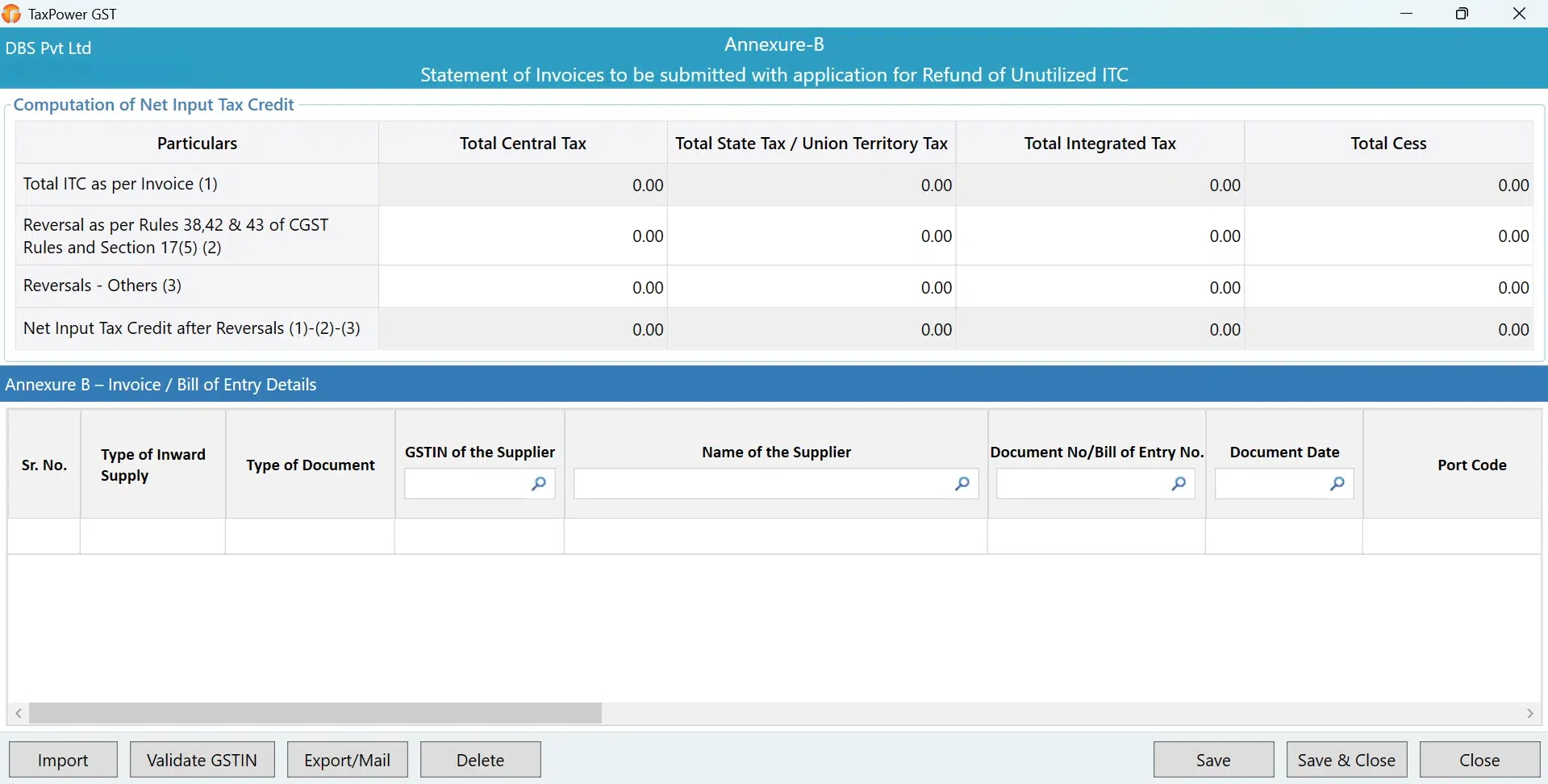
For CAs, GST practitioners, refund consultants and businesses handling accumulated ITC refund applications, this update can help in organizing invoice-wise data required for the revised Annexure-B workflow. It may also support a more structured approach while reviewing details such as supplier GSTIN, invoice number, invoice date, HSN/SAC, input supply category, ITC eligibility and reversal-related information.
However, users should carefully verify all data before filing the refund application. Particular attention should be given to invoices having multiple HSN/SAC codes, multiple input supply categories, GSTR-2B validation status, invalid document reports and ITC reversal reporting.
TaxPower GST does not guarantee refund approval or portal acceptance of every document. Final filing, data verification and compliance responsibility remain with the taxpayer and the professional handling the refund application.
For users who regularly prepare GST refund applications, TaxPower GST can help bring better discipline and organization to the revised Annexure-B preparation workflow.
What CAs and Refund Professionals Should Do Now
CAs, GST practitioners and refund consultants should treat this advisory as a workflow change, not merely a utility change.
The focus should now be on clean data preparation, invoice-level reconciliation, HSN/SAC mapping, ITC eligibility review and proper handling of reversal details.
Recommended actions
- Update internal refund filing checklists.
- Train staff on the new Annexure-B offline utility.
- Keep working papers for books vs GSTR-2B reconciliation.
- Review invoices with multiple HSN/SAC codes carefully.
- Maintain separate notes for blocked ITC, ineligible ITC and reversals.
- Review invalid document reports before final filing.
- Inform clients that refund filing may require more structured invoice-level data.
This can help reduce avoidable errors and improve refund filing discipline.
FAQs on GSTN Advisory 660 and Annexure-B Offline Utility
The following FAQs address common questions about filing of Annexure-B for refund applications involving accumulated ITC using the offline utility in GST portal.
Need Help Managing GST Refund Data More Systematically?
TaxPower GST supports professionals and businesses with practical GST compliance workflows, including refund-related data preparation, reconciliation and reporting support.
TaxPower GST Editorial Note
This article is prepared by the TaxPower GST team for general awareness and practical workflow understanding based on GSTN Advisory 660.
Our focus is to help taxpayers, CAs, GST practitioners and businesses understand important GST portal updates in a simple and actionable manner.
Public-facing GST, refund and compliance positions should always be reviewed with reference to the official GST portal advisory and applicable law before taking action.
Final Note / Disclaimer
This article is prepared for general awareness and workflow understanding based on GSTN Advisory 660 dated 18 May 2026. It should not be treated as legal advice or a substitute for professional judgment.
Taxpayers and professionals should refer to the official GST portal advisory, verify data carefully and review applicable law, rules, circulars and portal instructions before filing refund applications.
Final filing and compliance responsibility remains with the taxpayer and the professional handling the refund application.