GST Appeal Pre-Deposit Issue Solved: How to Link DRC-03 Payment Using Form DRC-03A (GSTN Advisory 2026)
GSTN has issued an important advisory on the payment of pre-deposit while filing an appeal before the First Appellate Authority. The clarification addresses a common issue faced by taxpayers who had already made voluntary payments during investigation through Form GST DRC-03, but later found that the GST portal still asked for pre-deposit at the time of appeal filing.
This issue arises because a payment made through DRC-03 is not automatically linked with the Demand ID created after issuance of the demand order. As a result, the portal may not recognize that earlier payment while checking the mandatory pre-deposit requirement for appeal filing.
Quick Answer
GSTN has clarified that payments made through Form GST DRC-03 are not automatically linked with the demand order issued by the department. Therefore, while filing an appeal, the GST portal may still ask for the mandatory pre-deposit. To resolve this issue, taxpayers must file Form GST DRC-03A to link the earlier DRC-03 payment with the relevant Demand ID so that the system recognizes the payment while calculating the pre-deposit.
Table of Contents
- What is Form GST DRC-03A?
- Background of the GSTN Advisory
- Mandatory Pre-Deposit Requirement for GST Appeals
- The Problem Faced by Taxpayers
- Why DRC-03 Payments Are Not Considered
- Role of Demand ID in the Electronic Liability Register
- How the GST Portal Checks Pre-Deposit
- GSTN Solution: Linking DRC-03 Payment Using Form GST DRC-03A
- Step-by-Step Process to Link DRC-03 Payment
- Comparison: DRC-03 vs Demand Payment
- Common Mistakes Taxpayers Should Avoid
- Pre-Appeal Compliance Checklist
- Key Takeaways
- Frequently Asked Questions
- Official GSTN Advisory
- Disclaimer
Table of Contents
- What is Form GST DRC-03A?
- Background of the GSTN Advisory
- Mandatory Pre-Deposit Requirement for GST Appeals
- The Problem Faced by Taxpayers
- Why DRC-03 Payments Are Not Considered
- Role of Demand ID in the Electronic Liability Register
- How the GST Portal Checks Pre-Deposit
- GSTN Solution: Linking DRC-03 Payment Using Form GST DRC-03A
- Step-by-Step Process to Link DRC-03 Payment
- Comparison: DRC-03 vs Demand Payment
- Common Mistakes Taxpayers Should Avoid
- Pre-Appeal Compliance Checklist
- Key Takeaways
- Frequently Asked Questions
- Official GSTN Advisory
- Disclaimer
What is Form GST DRC-03A?
Form GST DRC-03A is used to link a payment already made through Form GST DRC-03 with a specific demand order issued by the GST department.
Once this linking is completed, the payment becomes mapped to the relevant Demand ID in the Electronic Liability Register, allowing the GST portal to recognize it while calculating the mandatory pre-deposit for appeal filing.
Background of the GSTN Advisory
On 14 March 2026, GSTN issued an advisory on the payment of pre-deposit while filing an appeal before the First Appellate Authority. The advisory explains that many taxpayers voluntarily pay some amount during the investigation stage using Form GST DRC-03, but later face difficulty when filing an appeal because the GST portal still asks them to pay the pre-deposit. This happens even where they believe they have already paid sufficient amount earlier.
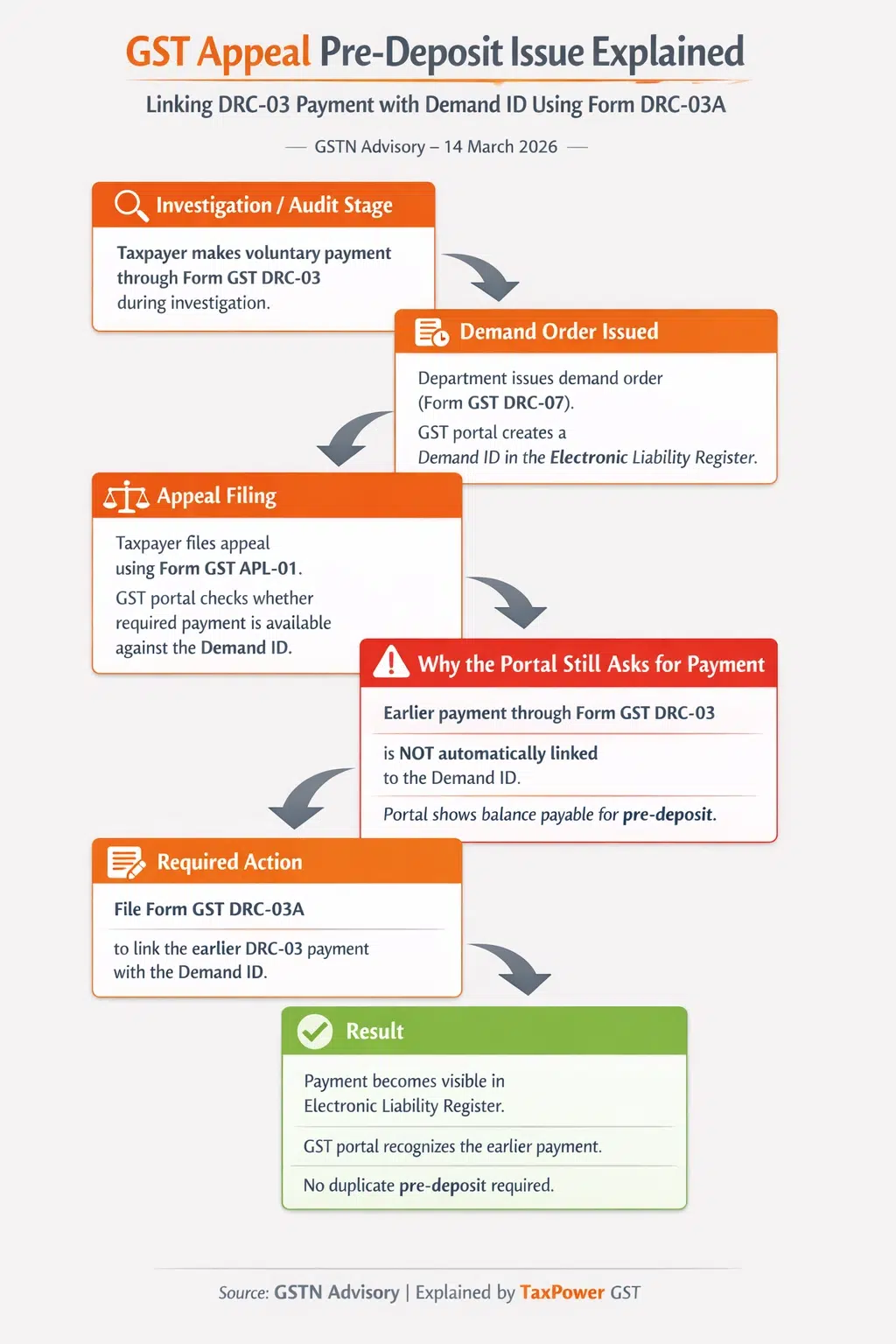
The advisory clarifies that when a demand order is issued, a Demand ID is created in Part II of the Electronic Liability Register. The GST system checks payment against that Demand ID while processing the appeal filing requirement. Payments made through DRC-03, however, are not automatically linked to that Demand ID. :contentReference[oaicite:2]{index=2}
Mandatory Pre-Deposit Requirement for GST Appeals
Under Section 107 of the CGST Act, a taxpayer filing an appeal before the First Appellate Authority is generally required to deposit the admitted tax amount and the prescribed percentage of the disputed tax amount as pre-deposit.
In practical portal terms, the GST system checks whether the required amount is reflected against the relevant Demand ID before allowing the appeal to proceed. Therefore, the issue is not only whether payment was made earlier, but whether that payment is visible to the GST system against the correct demand order.
The Problem Faced by Taxpayers
During investigations, taxpayers often make voluntary payments through Form GST DRC-03. Later, once the department issues a demand order, the taxpayer may decide to file an appeal. At that stage, the GST portal auto-calculates the required payment and checks whether any amount is already paid against the Demand ID in the Electronic Liability Register.
If the earlier payment through DRC-03 was never linked to that Demand ID, the portal does not treat it as adjusted against the demand. As a result, the taxpayer may feel that the portal is demanding payment again despite an earlier deposit already having been made. :contentReference[oaicite:3]{index=3}
Why DRC-03 Payments Are Not Considered for Pre-Deposit
Payments made through Form GST DRC-03 are not automatically recognized by the GST system against any specific Demand ID. Because of this, such payments do not appear as adjusted against the demand in the Electronic Liability Register.
This is the core reason why the GST portal may continue to show balance payable at the time of appeal filing, even if the taxpayer had already deposited an amount through DRC-03 during the earlier investigation stage. The system checks the Demand ID, not merely the existence of an earlier payment.
Role of Demand ID in the Electronic Liability Register
When a demand order such as Form GST DRC-07 is issued, the GST portal creates a Demand ID in Part II of the Electronic Liability Register. The portal relies on this Demand ID to determine whether any amount has already been paid toward that specific demand.
If payment is made using the portal’s “Payment Towards Demand” functionality, the amount is automatically adjusted against the relevant Demand ID. In contrast, a DRC-03 payment remains outside that automatic linkage unless it is subsequently connected using Form GST DRC-03A. :contentReference[oaicite:5]{index=5}
How the GST Portal Checks Pre-Deposit During Appeal Filing
While filing an appeal, the GST system auto-calculates the required amount to be paid, namely the admitted amount plus the mandatory pre-deposit, and then checks whether any amount has already been paid against the Demand ID in the Electronic Liability Register.
If the amount already reflected against the Demand ID is equal to or greater than the required amount, the portal allows the taxpayer to proceed without further payment. If the reflected amount is lower than the required amount, the portal asks for payment of the balance amount before the appeal can be filed.
Even if tax was paid earlier through DRC-03, the GST portal may still show shortfall if that payment was not linked to the relevant Demand ID.
GSTN Solution: Linking DRC-03 Payment Using Form GST DRC-03A
GSTN has advised taxpayers to file Form GST DRC-03A so that the payment earlier made through DRC-03 can be linked with the relevant demand order. Once linked, the corresponding entry becomes available in the Electronic Liability Register.
Form GST DRC-03A acts as the technical bridge between the earlier voluntary payment and the Demand ID created after issuance of the demand order. This is what enables the GST portal to recognize that earlier payment while calculating the mandatory pre-deposit requirement.
Before initiating appeal filing, verify whether the earlier DRC-03 payment has actually been reflected against the Demand ID. If not, file DRC-03A first to avoid unnecessary duplication of pre-deposit.
Step-by-Step Process to Link DRC-03 Payment with Demand ID Using Form GST DRC-03A
- Log in to the GST portal.
- Go to Services → User Services → My Applications.
- Select Form GST DRC-03A from the available application list.
- Enter or identify the relevant Demand ID from the demand order.
- Select the earlier DRC-03 ARN through which payment was made.
- Submit the form to link the payment with the demand.
- Verify that the payment is now reflected against the Demand ID in the Electronic Liability Register.
Before beginning this process, it is advisable to keep the demand order details and earlier DRC-03 reference handy to avoid mismatch during filing.
Keep the demand order details, Demand ID, and earlier DRC-03 reference ready before starting Form GST DRC-03A. This reduces the chances of mismatch and helps ensure that the earlier payment is correctly reflected before you proceed with appeal filing.
Comparison: DRC-03 Payment vs Payment Towards Demand
| Particular | DRC-03 Payment | Payment Towards Demand |
|---|---|---|
| Nature of payment | Voluntary payment | Demand-linked payment |
| Linked to Demand ID | No, not automatically | Yes |
| Reflected in Electronic Liability Register | Only after DRC-03A linkage | Automatically |
| Considered for appeal pre-deposit | Not unless linked | Yes |
| Required action | File Form GST DRC-03A | No additional linkage needed |
Common Mistakes Taxpayers Should Avoid
Many taxpayers mistakenly file a fresh DRC-03 thinking that the earlier payment was not recognized. In many cases, the issue is not non-payment but non-linking of the earlier payment with the Demand ID.
Filing a fresh DRC-03 unnecessarily
Some taxpayers may assume that a new voluntary payment is required when the portal continues to show balance payable. In many such cases, the real issue is not non-payment, but non-linking of the earlier payment with the Demand ID.
Ignoring the Demand ID mentioned in the order
The Demand ID is central to how the GST portal checks payment sufficiency during appeal filing. If the earlier payment is not mapped to that Demand ID, the portal may not treat it as paid for appeal purposes.
Filing appeal before verifying ledger reflection
Before proceeding with appeal filing, taxpayers should ensure that the earlier payment is correctly reflected in the Electronic Liability Register after filing DRC-03A.
Pre-Appeal Compliance Checklist for Taxpayers and CAs
- Verify that the demand order has been issued.
- Identify the correct Demand ID from the order.
- Check whether any earlier voluntary payment was made through DRC-03.
- File Form GST DRC-03A to link the earlier payment with the demand, wherever applicable.
- Confirm that the payment is visible in the Electronic Liability Register.
- Proceed with appeal filing only after verifying the pre-deposit position on the portal.
Key Takeaways
- Payment through Form GST DRC-03 is not automatically linked with the Demand ID.
- The GST portal checks payment against the Demand ID in the Electronic Liability Register while processing appeal pre-deposit requirements.
- If earlier DRC-03 payment is not linked, the portal may continue to ask for pre-deposit.
- Form GST DRC-03A is the required mechanism to link that earlier payment with the demand order.
- Taxpayers should complete this linkage before filing appeal wherever applicable.
Below are some common questions taxpayers and professionals may have regarding Form GST DRC-03A, GST appeal pre-deposit requirements, and the linking of earlier voluntary payments with demand orders on the GST portal.
Official GSTN Advisory
GSTN has specifically advised taxpayers to file Form GST DRC-03A to link payments made through Form GST DRC-03 with the relevant demand order before filing appeal, wherever applicable. Once such linkage is completed, the payment becomes available in the Electronic Liability Register and can be recognized by the GST portal while calculating the mandatory pre-deposit during appeal filing.
Support Your GST Compliance Workflow with Better Process Visibility
Tax professionals and businesses handling GST notices, orders, and appeal procedures benefit from better visibility of compliance documents and workflows.
You can also explore GST compliance features available in TaxPower GST to support document access, preparation of forms like DRC-03, and day-to-day GST compliance management.
Disclaimer
This article is for informational purposes only and is intended to help readers understand the GSTN advisory on pre-deposit while filing appeal before the First Appellate Authority. Taxpayers should consult their tax advisor or GST professional before acting on any legal or procedural matter.