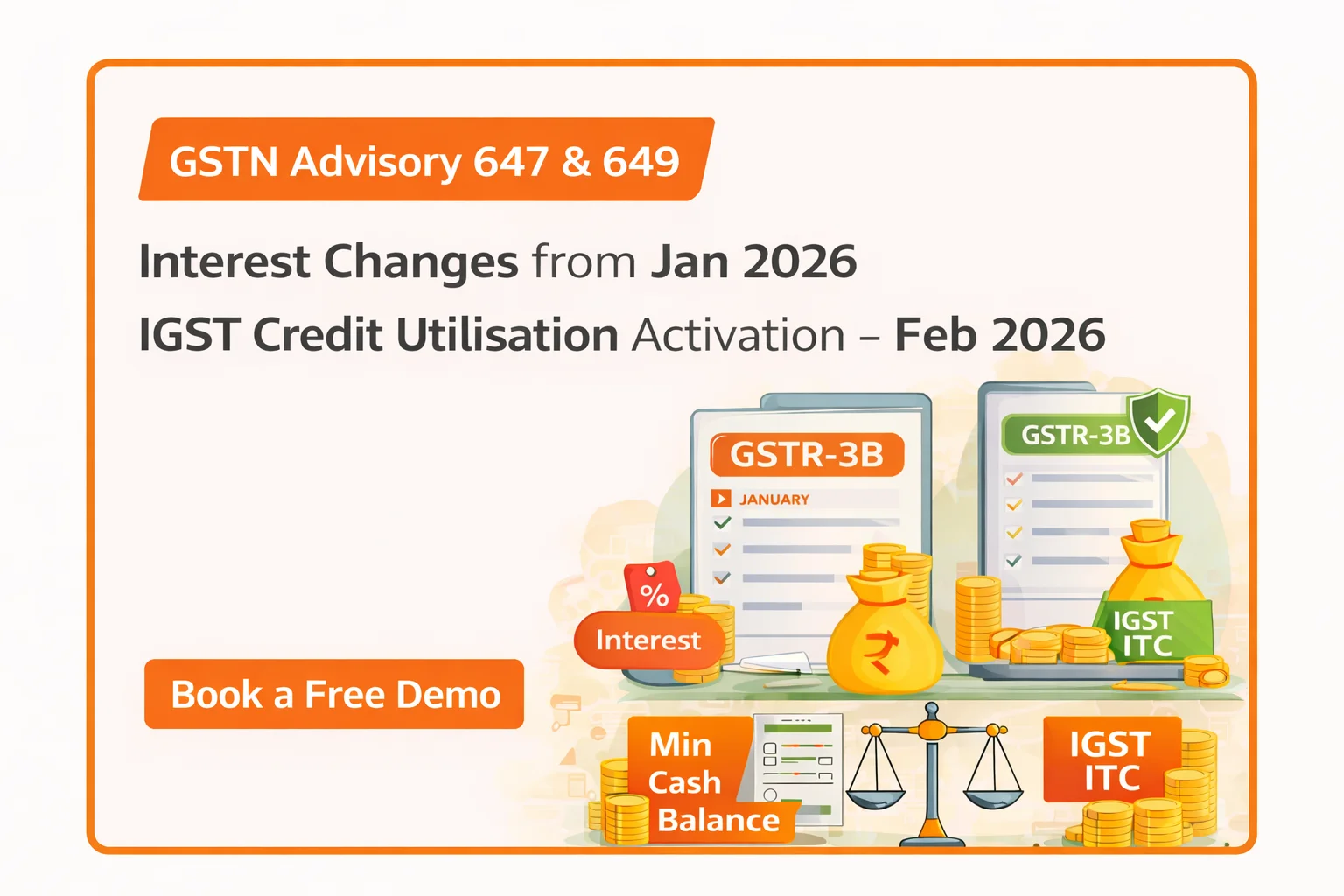
GSTN Advisory 647 & 649: Interest Calculation and IGST ITC Utilisation Changes in GSTR-3B (2026 Update)
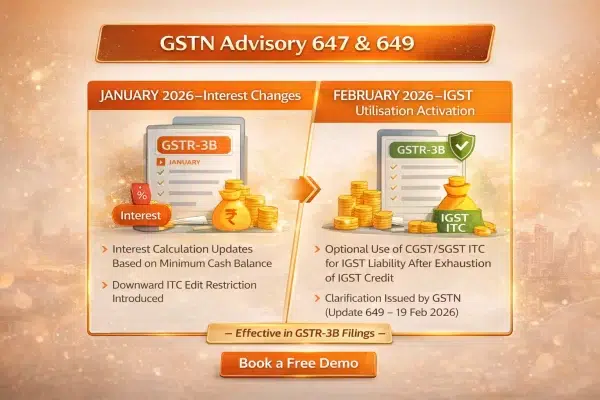
On 30 January 2026, GSTN issued Advisory No. 647 announcing key enhancements in interest calculation, tax liability breakup, and IGST credit utilisation while filing Form GSTR-3B.
These changes are effective from the January 2026 tax period and will reflect in GSTR-3B returns filed in February 2026 onwards. The portal’s behaviour is now aligned with the legal proviso of Rule 88B(1).
This blog explains the old method (pre-Jan 2026) and the new portal method (Jan 2026 onwards), along with impacts (positive/negative), process changes for filing GSTR-3B, and practical tips for taxpayers and CAs.
GSTN has clarified that the functionality to utilise CGST or SGST ITC for payment of IGST liability (in any order after complete exhaustion of IGST Credit) shall be available from February 2026 tax period onwards.
Accordingly, this flexibility will not apply to the January 2026 return period.
Table of Contents
1) Interest Calculation Before January 2026 – Practical Reality
Legal position vs portal behaviour (earlier)
Legally, interest under Section 50 read with Rule 88B(1) is payable only on the net tax liability paid in cash. However, before January 2026, the GST portal often did not fully factor the cash already available in the Electronic Cash Ledger (ECL) during the delay period. As a result, many taxpayers relied on manual working papers and faced avoidable disputes and scrutiny.
2) The New Interest Formula in GSTR-3B (Effective January 2026)
Core logic applied by the portal
New Rule (Portal Logic):
Interest is now calculated on your Net Tax Liability minus the Minimum Cash Balance maintained in your Electronic Cash Ledger (ECL) for the period from the due date of GSTR-3B until the date of actual tax payment/offset.
What is “Minimum Cash Balance” in ECL?
The minimum cash balance means the lowest balance available in the Electronic Cash Ledger during the delay period. Even if you deposit cash later, the interest benefit is available only to the extent of cash that was maintained (as the minimum balance) from the due date till payment. This change finally aligns the GST portal’s computation with the legal proviso of Rule 88B(1).
Interest Calculation Flow in GSTR-3B – Before vs After GSTN Advisory 647 and 649
Infographic explaining the change in interest calculation methodology in GSTR-3B before and after GSTN Advisory 647 (effective from Feb 2026)
3) System-Computed Interest Is Now Locked (Downward Edit Block)
From the January 2026 period, system-computed interest in Table 5.1 of GSTR-3B is non-editable downward. You may only increase the interest amount (upward adjustment), if required. This means the system-populated figure becomes the minimum mandatory interest for filing.
Practical impact: Any mistake in cash planning or late deposits may result in interest that cannot be reduced later. Interest planning must be done before filing, not at the filing stage.
4) Practical Example – Interest Saving Under the New System
Example: Interest saving due to minimum cash balance
- Net GST liability: ₹1,00,000
- Cash already available in ECL on due date: ₹40,000
- Delay: 20 days
Earlier (pre-Jan 2026): interest was often computed on the full ₹1,00,000.
Now (Jan 2026 onwards): interest is computed only on ₹60,000 (₹1,00,000 – ₹40,000). This rewards taxpayers who maintain adequate cash balance early.
5) New “Tax Liability Breakup” Feature – Silent but Powerful Change
What the portal auto-populates now
The portal now auto-populates a Tax Liability Breakup table based on the document dates and reporting in GSTR-1 / GSTR-1A / IFF. This enables the system to map tax to the correct tax period and compute interest accurately.
Important warning for taxpayers and CAs
Warning:
If you report past-period invoices in the current month’s GSTR-1, the system can still identify that the liability belongs to an earlier tax period and may compute interest for that specific past period. In short, late GSTR-1 reporting can now trigger interest even if the current GSTR-3B is filed on time.
6) New Flexibility in IGST Credit Utilisation (Major Relief)
As per GSTN Advisory 647, the portal logic enables CGST/SGST utilisation flexibility after IGST exhaustion. However, GSTN has subsequently clarified via an Update dated 19 February 2026 that this functionality will be operational from February 2026 return period onwards.
Example: ITC flexibility after IGST credit becomes zero
- IGST ITC: Nil
- CGST ITC: ₹50,000
- SGST ITC: ₹50,000
- IGST liability: ₹50,000
Now allowed: You can use 100% CGST ITC to pay IGST liability, leaving SGST ITC untouched (if that suits your cash/credit planning).
Implementation Timeline Clarification (GSTN Update 649)
While GSTN Advisory 647 introduced structural enhancements in interest calculation and ITC utilisation logic effective from the January 2026 tax period, GSTN has subsequently issued an update dated 19th February 2026 (Update ID 649) clarifying the operational timeline for IGST credit utilisation flexibility.
As per the clarification:
- The revised interest calculation mechanism based on Minimum Cash Balance in Electronic Cash Ledger continues to apply from January 2026 period onwards.
- However, the functionality allowing utilisation of CGST or SGST ITC for payment of IGST liability in any order after complete exhaustion of IGST credit shall be operational only from the February 2026 tax period onwards.
7) Before vs After – Old vs New System Comparison (Quick View)
| Aspect | Before Jan 2026 | From Jan 2026 |
|---|---|---|
| Interest base | Often computed on higher base (manual disputes) | Net liability minus minimum ECL cash balance |
| Cash balance benefit | Not consistently factored | System considers minimum cash balance during delay |
| Interest edit | Greater manual flexibility | Downward edit blocked; only upward allowed |
| Tax liability breakup | Less period-wise tracking | Auto-populated breakup based on document reporting dates |
| IGST utilisation | Restricted sequencing | Flexible CGST/SGST sequence after IGST ITC exhausted |
8) Special Provision for Cancelled Taxpayers – Interest Collection via GSTR-10
GSTN has clarified that if a taxpayer is cancelled and there is a delay in filing the last applicable GSTR-3B, the interest for such delay will now be levied and collected through GSTR-10 (Final Return). This adds clarity and reduces disputes in final return cases.
9) Impact on Taxpayers – Positive & Caution Areas
Positive impact
- Lower interest outflow for disciplined taxpayers maintaining adequate cash balance
- Portal computation aligned with Rule 88B(1), reducing disputes
- Better working capital flexibility due to improved IGST utilisation options
- Cleaner audit trail through tax liability breakup mapping
Caution / negative impact
- Once system interest is computed, you cannot reduce it (downward edit blocked)
- Late cash deposits or late GSTR-1 reporting may increase interest exposure automatically
- Higher dependency on correct return timelines and period-wise reporting discipline
10) How Your GSTR-3B Filing Process Must Change (Jan 2026 Onwards)
- Maintain a planned minimum cash balance in ECL before the due date (especially for large liabilities)
- Do not delay tax payment/offset unnecessarily if return filing is delayed
- File GSTR-1 on time to avoid past-period liabilities triggering interest automatically
- Review ITC balances and utilisation strategy before offset (especially IGST exhaustion scenarios)
11) Practical Tips to Reduce Interest & Avoid Filing Surprises
- Fund ECL before due date: even partial funding can reduce interest via minimum cash balance benefit.
- Avoid last-minute offset: interest window runs till actual payment/offset date.
- Discipline in GSTR-1 reporting: late invoices can lead to period-wise interest via breakup table.
- Maintain a monthly checklist: cash balance, liability mapping, ITC strategy, and filing timeline.
12) How TaxPower GST Helps Under the New Interest & ITC Regime
- Helps track cash ledger and ITC balances to support better filing decisions
- Supports planning to reduce interest exposure through timely funding and workflow checks
- Assists professionals with structured compliance steps for error-free GSTR-3B filing
FAQs on GSTN Advisory 647
Conclusion
GSTN Advisory 647 introduces a system-driven, law-aligned approach to interest computation and ITC utilisation in GSTR-3B, aligning portal functionality with the proviso to Rule 88B(1). The enhanced interest calculator, minimum cash balance consideration, and downward edit restriction represent a structural compliance shift effective from the January 2026 tax period.
Further, GSTN has clarified via Update dated 19th February 2026 (Update 649) that the flexibility to utilise CGST or SGST ITC for IGST liability in any order after exhaustion of IGST credit shall be operational from the February 2026 tax period onwards.
Accordingly, taxpayers must carefully distinguish between the January 2026 implementation of interest computation enhancements and the February 2026 operational activation of IGST ITC utilisation flexibility. Improved cash planning, accurate reporting discipline, and strategic ITC management are now essential to avoid irreversible interest exposure and compliance disruptions.
Referenced Documents
-
GSTN Advisory 647 – Advisory on Interest Collection and Related Enhancements in GSTR-3B (30 January 2026)
https://tutorial.gst.gov.in/downloads/news/advisory_on_interest_calculator.pdf -
GSTN Update 649 – Clarification on IGST ITC Utilisation Timeline (19 February 2026)
https://www.gst.gov.in/newsandupdates/read/649 - Rule 88B(1) of CGST Rules – Interest Computation Provisions
Disclaimer:
This blog is intended for informational purposes only and should not be considered legal or financial advice. Readers are encouraged to independently verify all applicable Indirect Taxes Acts, Rules, Notifications, GST Council resolutions, GST laws, regulations, CBIC advisories/circulars, GSTN guidelines, E-Way Bill and e-Invoice rules, and relevant judicial pronouncements before making decisions. The author and publisher are not responsible for any actions taken based on the information provided here.