STATUS UPDATE — 29 JULY 2026
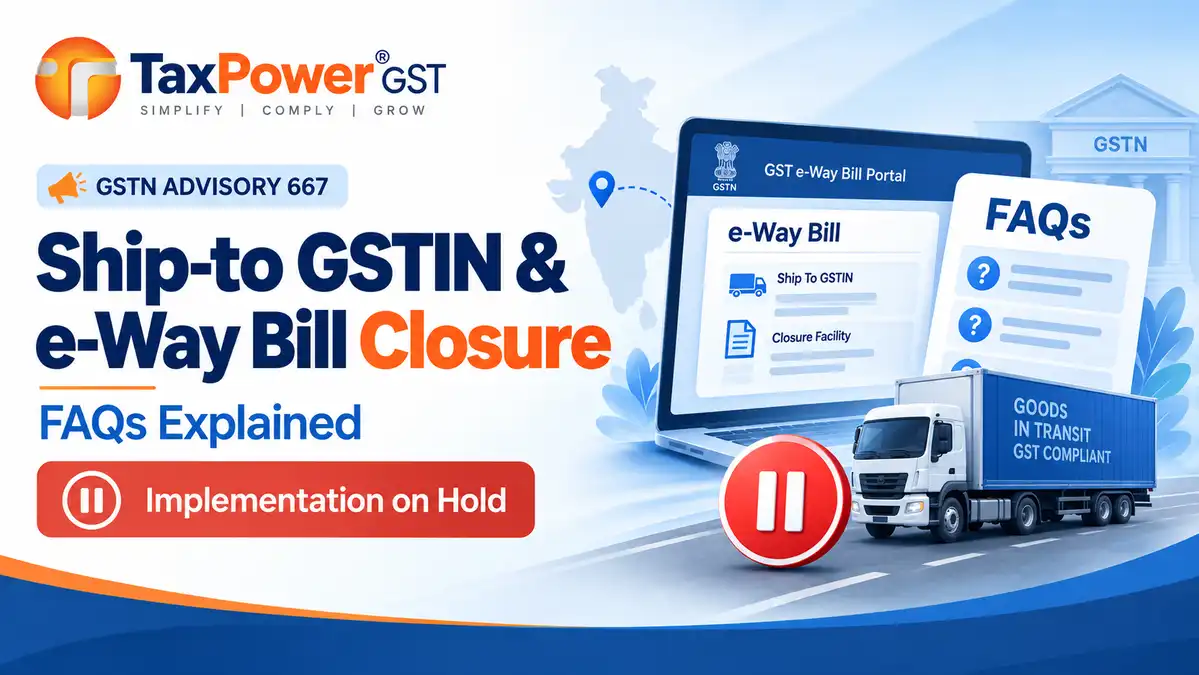
The proposed enhancements discussed in GSTN Advisory 667 and its FAQs are now on hold until further notice.
GSTN has advised that no related production-environment changes are required until further communication and that the related advisories and FAQs will be withdrawn from the GST Portal. Therefore, the 1 August 2026 implementation references below are retained only as part of the earlier proposal history and should not be treated as the current implementation position.
GST Update | GSTN Advisory 667 FAQs | Current Status: On Hold
GSTN Advisory 667 FAQs: Ship-to GSTIN and e-Way Bill Closure - Later Put on Hold
On 2 July 2026, GSTN published Advisory No. 667 with detailed FAQs on the proposed mandatory capture of Ship-to field / Ship-to GSTIN and the proposed voluntary closure of e-Way Bills.
The FAQs clarified stakeholder questions on business scenarios and API behaviour. However, GSTN Advisory 668 dated 29 July 2026 later kept these proposed enhancements on hold until further notice. The earlier 1 August 2026 implementation date is therefore not a current production deadline.
Read Current GSTN Hold AdvisoryWhat did GSTN Advisory 667 and its FAQs explain?
GSTN Advisory 667 and the linked FAQs described the proposed Ship-to GSTIN capture rules for Bill-to/Ship-to and Combination transactions and the proposed voluntary e-Way Bill Closure facility.
Before the later hold, the FAQs described business scenarios, confidentiality of Ship-to GSTIN, API impact, e-Invoice and e-Way Bill by IRN flows, portal closure modes, closure timing and API limitations. GSTN Advisory 668 subsequently put the proposed implementation on hold.
Table of Contents
Why this advisory is important
GSTN Advisory 661 introduced the broad proposed changes in the e-Way Bill system. Advisory 667 goes deeper and answers practical stakeholder questions through two detailed FAQ documents.
For businesses, transporters, ERP/API users, GST professionals and CAs, this advisory is important because it explains how the changes may work in real business situations such as Bill-to/Ship-to transactions, export-linked movements, e-Invoice flows and e-Way Bill Closure after delivery.
Ship-to GSTIN clarification
The FAQ explains when Ship-to GSTIN is required, when URP may be used and how different transaction types should be treated.
EWB Closure clarification
The FAQ explains voluntary e-Way Bill Closure, portal modes, API limits, closure timing and post-closure behaviour.
Ship-to GSTIN rules proposed for August 2026 (currently on hold)
The FAQ published on 2 July 2026 stated that, under the proposed implementation, Ship-to GSTIN would be captured as a mandatory data element in Bill-to/Ship-to and Combination transactions wherever the Ship-to party is registered.
The same FAQ stated that where GSTIN was not available, “URP” could be entered wherever applicable and that “URP” is not case-sensitive. These points are retained here only as historical proposal detail while the implementation remains on hold.
Purpose stated in the proposal: Ship-to GSTIN was proposed to be captured to improve traceability of goods movement, strengthen audit trail in Bill-to/Ship-to transactions and support system-based verification by authorised officers.
Transaction Matrix: When is Ship-to GSTIN required?
The FAQ document explains different transaction types. This matrix gives a quick practical view for taxpayers, GST professionals and ERP/API users.
| Transaction Type | Billing Flow | Movement of Goods | Ship-to GSTIN Rule | Portal / API Treatment |
|---|---|---|---|---|
| Regular | Supplier to Buyer | Supplier to Buyer | Not applicable | Do not enter Ship-to GSTIN. In API, sending it may trigger Error 616. |
| Bill-to / Ship-to | Supplier to Buyer | Supplier to Third Party | Mandatory where Ship-to party is registered | Enter Ship-to GSTIN or URP where applicable. |
| Bill-from / Dispatch-from | Supplier to Buyer | Third Party to Buyer | Not required | Do not enter Ship-to GSTIN. In API, sending it may trigger Error 864. |
| Combination | Supplier to Buyer | Third Party to Fourth Party | Mandatory where Ship-to party is registered | Enter Ship-to GSTIN or URP where applicable. |
Important clarification: Bill-to GSTIN and Ship-to GSTIN should not be the same
The FAQ clarifies that in a Bill-to/Ship-to transaction, the Bill-to party and Ship-to party are expected to be distinct persons. Therefore, the same GSTIN as mentioned in the Bill-to field should not be entered in the Ship-to GSTIN field.
Correct Bill-to / Ship-to case
A supplier bills the buyer, but goods are delivered to a third party on the buyer’s instruction. Ship-to GSTIN is required where the third party is registered.
Not a Bill-to / Ship-to case
If goods are delivered to the buyer’s own warehouse, branch or additional place of business, the transaction should not be treated as Bill-to/Ship-to merely because the delivery address is different.
Quick decision logic for businesses and GST teams
- If goods are delivered to the buyer’s own warehouse, branch or additional place of business, then treat it as a regular transaction and do not use the Bill-to/Ship-to option only because the address is different.
- If goods are billed to one party but delivered to a third party on the buyer’s instruction, then treat it as a Bill-to/Ship-to transaction and capture Ship-to GSTIN where the Ship-to party is registered.
- If the buyer does not want to disclose Ship-to GSTIN to the supplier or transporter due to trade confidentiality, then the buyer may generate the e-Way Bill themselves.
- If export goods are moved to an export-linked location and no domestic registered Ship-to GSTIN is applicable, then URP may be used wherever applicable.
- If an e-Way Bill is closed after delivery, then remember that closure is not cancellation and not expiry.
Confidentiality of Ship-to GSTIN
One important concern raised by stakeholders was trade secrecy. The FAQ clarifies that Ship-to GSTIN will not be printed on the e-Way Bill generated on the e-Way Bill portal.
It also clarifies that Ship-to GSTIN will not be provided through GET e-Way Bill APIs. The relevant Ship-to address and PIN code will continue to be visible as per the existing practice.
Not printed on EWB
Ship-to GSTIN will not be printed on the taxpayer / transporter-facing e-Way Bill.
Not shared through GET APIs
Ship-to GSTIN will not be provided through GET e-Way Bill APIs. It will be captured in the system for official purposes.
URP in e-Way Bill export transactions
The FAQs also clarify export-related situations. In export transactions, goods may be billed to an overseas buyer but physically moved from the supplier’s premises in India to a port, airport, ICD, CFS, customs area, freight forwarder location, CHA-nominated premises or another export-linked location.
In export sub-supply type involving Bill-to/Ship-to transactions, Ship-to GSTIN is proposed to be entered as URP where the Ship-to location is export-linked and no domestic registered Ship-to GSTIN is applicable.
Important: Entering URP in such export-linked movement does not mean that the transaction is treated as a domestic supply to an unregistered person. The nature of export depends on export invoice, shipping bill, customs documents, transport documents and other applicable records.
Bill-to Ship-to e-Way Bill error codes for ERP/API users
The FAQ provides detailed clarifications for ERP vendors, GSPs, ASPs, IRPs and system integrators. These system validation codes are useful for sandbox testing and API readiness.
| Validation Scenario | Error Code | Practical Meaning |
|---|---|---|
| Ship-to GSTIN missing in Ship-to / Combination transactions | 608 | Ship-to GSTIN is required where applicable. |
| Ship-to GSTIN sent in Regular transactions | 616 | Ship-to GSTIN should not be sent in regular transactions. |
| Ship-to GSTIN sent in Bill-from / Dispatch-from transactions | 864 | Ship-to GSTIN is not required where delivery is to the buyer already declared as Bill-to party. |
| Bill-to GSTIN and Ship-to GSTIN are same in Ship-to / Combination transactions | 618 | Bill-to and Ship-to parties are expected to be distinct in such transactions. |
| Attempting to replace ship details during e-Way Bill by IRN for B2B or SEZ transactions | 2324 | Replacement of ship details is allowed for Export EWBs, but not for B2B / SEZ cases where restricted. |
API, e-Invoice and e-Way Bill by IRN impact
Standalone e-Way Bill API
Under the proposed API changes, Ship-to GSTIN was to be mandatory in Ship-to and Combination transactions and was not to be sent in Regular or Bill-from / Dispatch-from transactions.
Generate IRN + EWB together
Under the proposed flow, Ship-to GSTIN was to be mandatory where ship details are provided and e-Way Bill generation is required; Bill-to and Ship-to GSTIN were not to be the same in the specified cases.
e-Way Bill by IRN API
The proposed e-Way Bill by IRN API material added GSTIN and Trade Name in ExpShipDtls and described GSTIN as mandatory in the specified flow. These specifications should be read as historical proposal material while implementation is on hold.
Sandbox readiness
GSTN has since stated that no related production-environment changes are required until further communication. Any earlier sandbox material should be treated only as technical reference, not as a production go-live instruction.
Voluntary e-Way Bill Closure: Key clarification
The second FAQ document described a proposed voluntary e-Way Bill Closure facility for recording completion of movement after delivery. GSTN later placed the proposed enhancement on hold until further notice.
The FAQ had described e-Way Bill Closure as voluntary and had referred to 1 August 2026 as the revised implementation date. GSTN Advisory 668 later superseded that timeline by placing the proposed enhancements on hold until further notice.
Closure is after delivery
Closure is used after delivery of goods has been completed. It is not the same as cancellation or expiry.
Closure is voluntary
Businesses should not operationalise a closure process solely on this held proposal.
What did the withdrawn FAQ say about closure timing?
Under the proposed facility described in the FAQ, an e-Way Bill was to be closed after completion of delivery, on the date of delivery or on the immediately succeeding day.
The FAQ also described a system validation under which the proposed closure functionality could remain available up to one day after expiry of the e-Way Bill validity. This is historical proposal detail, not a current production requirement.
Example
If an e-Way Bill is generated on 20 June 2026 and its validity expires on 30 June 2026, and goods are received on 25 June 2026, the FAQ example indicated a proposed closure window from 25 June 2026 up to 1 July 2026.
Who did the proposed closure facility allow to close an e-Way Bill?
The FAQ described the proposed facility as allowing closure by the supplier, recipient, transporter involved in the transaction, or a driver / authorised person whose mobile number had been provided for closure.
Supplier / Recipient
The FAQ described a post-login closure option under the e-Way Bill section of the portal.
Transporter
The FAQ described portal-based closure options for transporters where applicable.
Driver / Authorised Person
The proposed process also described a portal-based mobile number facility for a driver / authorised person where a mobile number had been provided.
e-Way Bill closure API limitations
The FAQ described an API for system integrators and API users under the proposed closure facility, using the e-Way Bill number, closure date and remarks, with remarks up to 100 characters. These API details are retained as historical technical reference while the proposal remains on hold.
Important API boundary: The FAQ described driver / authorised person closure through mobile number as a portal-only facility and did not describe API support for that mobile-based access.
| API / System Point | Position described in the FAQ/API material |
|---|---|
| Closure API | Described using e-Way Bill number, closure date and remarks. |
| Date-wise bulk closure through API | Not supported in the FAQ/API material. |
| API to retrieve closed EWBs date-wise | Not available in the FAQ/API material. |
| Closed status / Closed date in Get EWB Details API | Not separately returned in the described API response. |
| Driver / authorised person closure through API | Not available in the FAQ/API material. Portal-only facility. |
| ClosedBy field in API response | Not available in the FAQ/API material. |
Status and post-closure behaviour
The FAQ stated that a separate status of “Closed” was proposed to be introduced in due course for e-Way Bills that have been marked as closed after completion of delivery.
For the proposed initial stabilisation period, the FAQ described continuation of the existing Active, Cancelled or Discarded status framework, with closure details captured without necessarily showing a separate Closed status immediately.
The FAQ indicated that certain permitted actions could continue even after closure during the proposed initial stabilisation period, with possible restrictions after stabilisation. This is not a current production instruction while the enhancement is on hold.
Closure is not cancellation or expiry
Closure
Under the proposal, closure was a user action intended to record completion of delivery after goods had been delivered.
Cancellation
Cancellation is used where an e-Way Bill was wrongly generated or movement did not take place, subject to applicable rules.
Expiry
Expiry is based on the validity period of the e-Way Bill. It is different from voluntary closure after delivery.
Training point
If GSTN reintroduces the facility, billing, dispatch, logistics and GST teams should distinguish closure from cancellation and expiry before operational use.
What businesses should do while implementation is on hold
GSTN has put the proposed enhancements on hold until further notice. Businesses should not treat the earlier 1 August 2026 date as an active implementation deadline. The earlier FAQ should now be used only as background and technical reference until GSTN issues further communication.
1. Identify transaction types
Classify transactions into Regular, Bill-to/Ship-to, Bill-from/Dispatch-from and Combination.
2. Review Ship-to GSTIN or URP mapping
Review Ship-to GSTIN and URP mapping for future readiness, but do not make proposal-driven production changes until GSTN issues further communication.
3. Review export-linked locations
Identify export-linked locations where URP treatment may apply.
4. Review ERP/API impact
Review standalone EWB, IRN + EWB and EWB by IRN flows as technical reference; keep any testing separate from production rollout.
5. Brief operational teams
Inform billing, dispatch, logistics, transporter coordination and GST teams that the proposed implementation is currently on hold.
6. Keep the closure process as reference
Do not operationalise the proposed closure workflow solely on the held proposal; retain it as reference until GSTN re-announces implementation.
What GST professionals should tell clients
CAs, tax practitioners and GST consultants should guide clients in a practical and non-alarming manner. Advisory 667 should now be read as background to a proposal that GSTN has placed on hold. Clients should not be told that 1 August 2026 remains an active implementation deadline.
- Review Bill-to/Ship-to and Combination transactions.
- Review possible ERP/API impact, but do not deploy proposal-driven production changes until further GSTN communication.
- Understand confidentiality of Ship-to GSTIN.
- Avoid wrong transaction classification.
- Keep Ship-to GSTIN / URP concepts documented for reference and future readiness.
- Review export and merchant exporter scenarios.
- Do not operationalise an e-Way Bill Closure SOP solely on the held proposal.
- Any optional technical testing should remain separate from production rollout while the proposal is on hold.
TaxPower GST Readiness Note
GSTN has kept the proposed enhancements covered by Advisory 667 and its FAQs on hold until further notice. TaxPower GST users should not treat the earlier implementation timeline as a current production requirement.
The earlier FAQ documents remain useful as historical and technical background on Ship-to GSTIN, URP, Bill-to/Ship-to transactions, API validations and voluntary e-Way Bill Closure, but they should not be used as the basis for live production changes while implementation is on hold.
TaxPower GST will continue to track further official GSTN communication. Any product-related change should be evaluated only after GSTN confirms a fresh implementation position. Users should verify the latest official portal communication before making operational changes.
Contact TaxPower GST SupportFAQs on GSTN Advisory 667
1. What did GSTN Advisory 667 and its FAQs explain?
GSTN Advisory 667 dated 2 July 2026 provides links to detailed FAQs on mandatory capture of Ship-to field / Ship-to GSTIN and voluntary closure of e-Way Bills.
2. What is the revised implementation date mentioned in the FAQ documents?
The FAQ documents originally mentioned 1 August 2026. GSTN later placed the proposed enhancements on hold until further notice on 29 July 2026, so 1 August 2026 should not be treated as a current implementation deadline.
3. Is Ship-to GSTIN mandatory in every e-Way Bill?
No. Ship-to GSTIN is not applicable to every e-Way Bill. It is required in Bill-to/Ship-to and Combination transactions wherever the Ship-to party is registered.
4. What should be entered if Ship-to GSTIN is not available?
Where GSTIN is not available, URP may be entered wherever applicable. GSTN has clarified that URP is not case-sensitive.
5. Can Bill-to GSTIN and Ship-to GSTIN be the same?
No. In Bill-to/Ship-to and Combination transactions, Bill-to GSTIN and Ship-to GSTIN should not be the same.
6. Will Ship-to GSTIN be printed on the e-Way Bill?
No. The FAQ clarifies that Ship-to GSTIN will not be printed on the e-Way Bill.
7. Will Ship-to GSTIN be available through GET e-Way Bill APIs?
No. Ship-to GSTIN shall not be provided through GET e-Way Bill APIs.
8. Is voluntary e-Way Bill Closure mandatory?
No. The FAQ clearly states that closure of e-Way Bill is voluntary in nature.
9. Who did the proposed closure facility allow to close an e-Way Bill?
An e-Way Bill may be closed by the supplier, recipient, transporter involved in the transaction, or driver / authorised person whose mobile number has been provided for closure.
10. Is closure the same as cancellation?
No. Cancellation is used where an e-Way Bill was wrongly generated or movement did not take place, subject to applicable rules. Closure is used after delivery has been completed.
11. Is an API available for e-Way Bill Closure?
Yes. An API has been provided for closure of e-Way Bills. It requires e-Way Bill number, closure date and remarks.
12. Does the closure API support date-wise bulk closure?
No. The current API does not support date-wise bulk closure.
Final Note
This article records the FAQ material published under GSTN Advisory No. 667 dated 2 July 2026 together with the current hold position announced by GSTN Advisory 668 dated 29 July 2026.
GSTN stated on 29 July 2026 that implementation was kept on hold until further notice, that no related production-environment changes were required until further communication, and that the related advisories and FAQs would be withdrawn. The earlier FAQ material below should therefore be treated only as historical and technical background.
This article is intended for general awareness and practical preparedness only. It should not be treated as legal advice, tax opinion or a substitute for professional review of specific transactions.
Current GSTN status: Advisory 668 dated 29 July 2026 - proposed e-Way Bill enhancements kept on hold
Historical GSTN FAQ update: GSTN Advisory No. 667 dated 2 July 2026
Ship-to GSTIN FAQs: FAQs on Bill-to/Ship-to Transactions, Export Scenarios and API Impact
EWB Closure FAQs: FAQs on Voluntary Closure of e-Way Bill
Related TaxPower GST Resources
You may also find these TaxPower GST resources useful for GST return review, reporting and compliance workflows.
Earlier Advisory 661 Blog
Read the earlier blog explaining proposed e-Way Bill portal enhancements.
Read Advisory 661 blog →GST Return Filing Workflow
Review GST return preparation and filing workflow support in TaxPower GST.
Know more →GST Reports and Compliance Review
Explore GST reports useful for review, checking and compliance preparation.
View GST reports →Need help with TaxPower GST?
Contact our team for product support, demo or GST software inquiry.
Contact us →