
Top 4 IMS Mistake Solutions: Recover ITC & Fix Rejected Invoices Fast! (GSTN Advisory Explained)
Did you accidentally reject an invoice or credit note in GST’s Invoice Management System (IMS)? Are you worried about losing Input Tax Credit (ITC) or increasing your GST liability? Don’t panic! The latest GSTN Advisory (June 2025) delivers four powerful solutions to help tax filers and suppliers recover ITC, fix rejected invoices and stay GST compliant—even if you’ve already filed your GSTR-3B. This essential guide explains the step-by-step process with real-life scenarios and shows why TaxPower GST is your go-to tool for seamless IMS reconciliation and reporting.
If you’re new to IMS, check out our full IMS background guide for history, meaning, and timeline.
Table of Contents
What is the Invoice Management System (IMS) in GST?
The Invoice Management System (IMS) is a GST portal module for B2B tax filers to accept, reject, or keep pending invoices and credit notes before they are auto-locked in GSTR-2B for ITC claims. IMS was rolled out in phases starting in 2024 and is now mandatory for most GST taxpayers in 2025. IMS enables better ITC control and reduces mismatches—but can be complex, especially if you’re dealing with high volumes of data or make errors.
For more details and FAQ, see our IMS blog or the official GSTN Advisory on IMS Rollout.
Why IMS Mistakes Happen: Real-Life Tax Filer Problems
With IMS, every B2B invoice and credit note must be acted on—accept, reject, or keep pending. Mistakes are common, such as:
Tax filers often ask: – Can I recover ITC after a mistake in IMS? – How can suppliers fix liability if I reject a record? – What if GSTR-3B is already filed?
IMS Mistake Solutions: All Scenarios Explained (with Practical Examples)
| ❓Question | ✅Solution / Answer | 💡Example / Illustration |
|---|---|---|
| 1. How can a recipient avail ITC for a wrongly rejected invoice or debit note in IMS when GSTR-3B is already filed? |
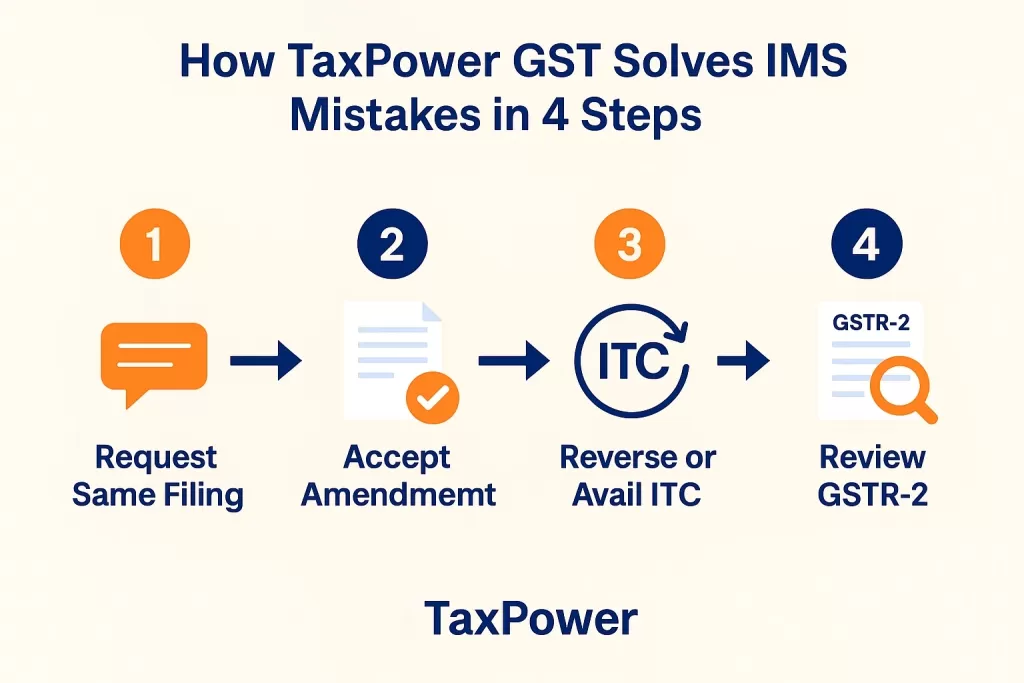
• Ask supplier to re-report the exact same invoice/debit note in GSTR-1A (same period) or amendment table of subsequent GSTR-1/IFF. • Accept the document in IMS when it reappears. • Recompute GSTR-2B—your ITC is restored for the amended value. |
Example: You accidentally reject Invoice #1101 in IMS and have filed GSTR-3B. You request your supplier to furnish Invoice #1101 again in GSTR-1A. Once it shows up in IMS, you accept it and get your ITC in the correct GSTR-2B period. |
| 2. If the supplier re-furnishes the record after recipient’s rejection, does the supplier’s liability increase? |
• Supplier re-furnishes the exact same document in GSTR-1A or amendment table. • The amendment table only takes the difference (“delta” value). • No additional liability is created if the value is unchanged. |
Example: Supplier reports Invoice #1101 in GSTR-1A after recipient’s rejection in IMS. Since the value is unchanged, the amendment adds nothing new—supplier’s tax liability remains unaffected. |
| 3. How to reverse ITC for a wrongly rejected Credit Note in IMS when GSTR-3B is already filed? |
• Request supplier to report the same Credit Note in GSTR-1A or amendment table. • Accept the amended CN in IMS and recompute GSTR-2B. • ITC will be reduced by the value of the original Credit Note. |
Example: You wrongly reject Credit Note #CN301 in IMS, but already filed GSTR-3B. Ask the supplier to re-furnish CN301; once you accept it in IMS, your ITC is automatically reduced for that amount. |
| 4. What impact does re-furnishing a Credit Note have on the supplier’s liability? |
• Supplier’s liability may be temporarily added back due to the initial rejection. • When the supplier re-furnishes the Credit Note, liability is reduced again for the same value. • Net impact: Supplier’s liability is only affected once for the correct amount. |
Example: Supplier’s Credit Note #CN301 was rejected in IMS, liability is added back in GSTR-3B. Supplier refurnishes CN301, and their liability reduces accordingly—no double tax. |

How TaxPower GST Makes IMS Management Effortless
With TaxPower GST, you never have to panic about IMS mistakes:
- Bulk IMS Actions: Accept, reject, or amend records in a single dashboard
- Error Alerts: Get instant notifications for possible mistakes or pending IMS actions
- Direct Communication: Prompt suppliers/clients to fix errors quickly
- Seamless Reconciliation: Automatic GSTR-2B and GSTR-1 matching for every client
- Detailed IMS Reports: Track every amendment, ITC change, and document status—ready for audit or compliance review
- Trusted by Hundreds: Clients have recovered ITC, managed amendments, and simplified GST compliance with TaxPower GST’s IMS tools. Try it free for 30 days!
FAQs: IMS Mistake Solutions, ITC, and Amendments
Can I recover ITC after mistakenly rejecting an invoice in IMS?
Yes! If your supplier re-furnishes the same invoice in GSTR-1A or the amendment table, and you accept it on IMS, you can claim ITC in GSTR-2B for that period.
Will my supplier’s tax liability go up due to my IMS rejection?
No, as long as the supplier re-reports the same value, the net liability remains unchanged (only the delta is counted in the amendment table).
Does TaxPower GST help with IMS mistake recovery and reporting?
Absolutely! With bulk IMS tools, error alerts, supplier notifications, and reconciliation reports, TaxPower GST is your best solution for audit-ready compliance.
Where can I find official guidance and more details on IMS?
See our IMS Guide and the latest GSTN advisories for full references.
Conclusion: Recover ITC & Fix IMS Mistakes Fast with TaxPower GST
IMS mistakes are common, but the new GSTN advisory and the right GST software make recovery easy. With TaxPower GST, you can handle IMS errors, restore ITC, amend records, and file returns confidently—all from one dashboard.
Don’t risk losing ITC—start your 30-day free trial and experience seamless IMS mistake solutions with TaxPower GST!
Disclaimer: This blog is intended for informational purposes only and should not be considered legal or financial advice. Readers are encouraged to independently verify all applicable GST laws, regulations, CBIC advisories, GSTN guidelines, and E-Way Bill rules before making decisions. The author and publisher are not responsible for any actions taken based on the information provided here.