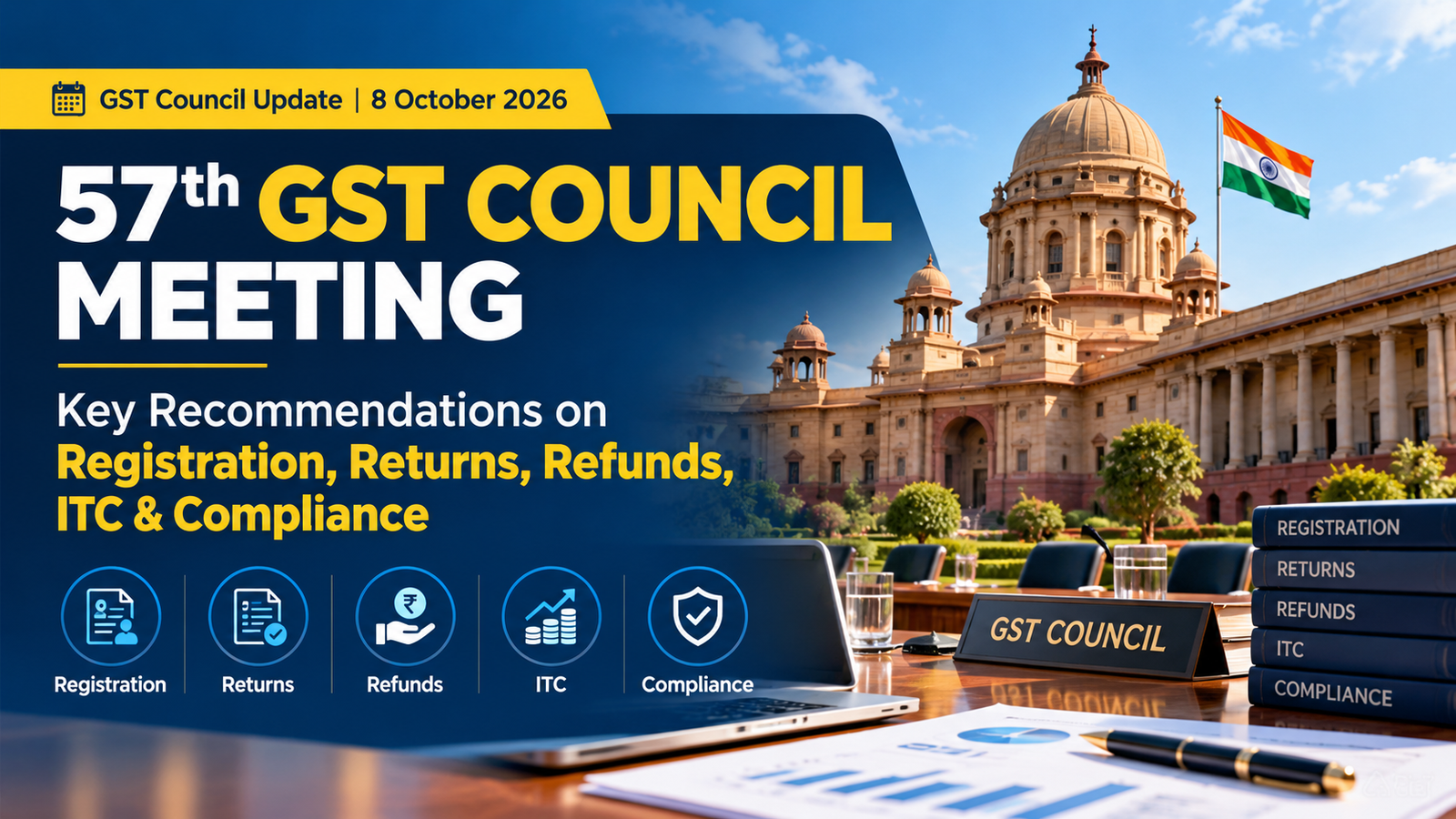
GST COUNCIL UPDATE | 57TH MEETING | 8 OCTOBER 2026
Focus: Registration, returns, refunds, adjudication, ITC, e-way bill and other GST compliance reforms
57th GST Council Meeting: Key Recommendations on Registration, Returns, Refunds, ITC & Compliance
The 57th GST Council Meeting, held on 8 October 2026, focused heavily on process reforms rather than only tax-rate changes. The Council recommended a series of measures covering GST registration, return filing, refunds, input tax credit, notices and adjudication, e-way bills, prosecution and other compliance processes.
For CAs, tax practitioners, compliance teams and businesses, the most important point is that these are GST Council recommendations. They will acquire legal effect only through the relevant notifications, circulars and amendments to the law or rules, as applicable.
Quick Answer
What is the biggest takeaway from the 57th GST Council Meeting? The Council has recommended a broad shift toward more automated registration and refund processes, better reconciliation between GSTR-1/1A/IFF and GSTR-3B, new electronic statements for RCM and ITC reversal/reclaim, lower compliance friction in notices and penalties, and reduced officer interface in several GST processes. Some return-related reforms are proposed to apply from the April 2027 return period, subject to the required legal and system changes.
Important: Recommendations Are Not Yet the Law
The official PIB release itself states that the recommendations will be given effect through the relevant circulars, notifications and law amendments, and that those instruments alone will have the force of law. Businesses and professionals should therefore avoid treating every recommendation below as already effective.
Official FAQ Update: Key Clarifications Issued After the 57th GST Council Meeting
GSTN ADVISORY 676 | 13 OCTOBER 2026
GSTN subsequently published official FAQs on the 57th GST Council recommendations. The FAQs add useful operational detail to several proposals discussed in this article.
- Inverted duty structure (IDS): a higher tax rate on input services alone does not create an inverted duty structure. The existence of IDS continues to be determined by comparing the tax rate on inputs with the tax rate on output supplies. Once such inversion exists, eligible input-service ITC and the attributable portion of eligible capital-goods ITC may be included in the refund computation, subject to the proposed effective dates and legal changes.
- Capital-goods ITC refund: eligible capital-goods ITC is proposed to be considered over 60 months, at one-sixtieth for each month, for ITC availed on or after 1 April 2027. The FAQ covers its inclusion for zero-rated supplies made without payment of tax under bond/LUT and for inverted-duty-structure refunds.
- ₹10,000 show-cause-notice threshold: the threshold is to be tested on the aggregate tax involved under CGST, SGST/UTGST, IGST and applicable cess. Interest, late fee and penalty are not to be counted for determining whether this threshold is met.
- E-way bill interception safeguards: the proposed framework requires authorisation from a proper officer not below the rank of Joint Commissioner who has reasons to believe, recorded in writing, that the goods are being transported in contravention of the law. Transit-State officers are not to inspect, detain or seize in such cases and, if they notice a contravention, are expected to allow movement and transmit the information to the officer having jurisdiction over the supplier or recipient.
- Rule 14B for small ECO sellers: the FAQ clarifies that the simplified registration route is for goods supplied exclusively through an ECO, requires ECO consent for use of its warehouse as PPoB/APoB, and permits a single registration against a PAN in a State/UT under the scheme, subject to the prescribed conditions.
- Registration and cancellation: the FAQs provide further detail on automatic amendments, ECO-related registration processing and system-based cancellation, including the need to clear pending returns and dues for specified cancellation routes.
Legal-status reminder: GSTN expressly states that the FAQ answers are for educational and guidance purposes and do not have independent legal validity. Taxpayers should rely on the relevant notifications, circulars, amendments and effective dates before implementation.
In This Update
1. GST Registration Reforms Recommended
The Council recommended several changes intended to make registration filing and processing more predictable and reduce avoidable queries.
- Clearer registration documentation: a comprehensive circular and FAQs are proposed to specify the documents and information required for GST registration.
- FORM GST REG-01 changes: prescribed documents/information may be selected through drop boxes to improve clarity for applicants and officers.
- More user-friendly portal flow: the Council recommended clearer navigation, drop-downs, tool-tips and contextual guidance on the GST Portal.
- Automatic acceptance of amendments: rule 19 is proposed to be amended so that amendments to registration particulars are automatically accepted, except changes relating to the Principal Place of Business (PPoB). For taxpayers registered under rule 14A, the recommendation extends automatic acceptance to PPoB changes as well.
- Simplified cancellation: the Council recommended a phased system-based cancellation mechanism for taxpayer-initiated cancellations, subject to pending returns and dues being cleared, along with system-based mechanisms for certain suo-moto cancellation and revocation cases.
- Small sellers on e-commerce platforms: the Council recommended insertion of rule 14B for a simplified registration mechanism for qualifying small suppliers of goods operating through ECOs in States/UTs where they do not have a physical presence. The subsequent official FAQ clarifies that this route is for goods supplied exclusively through an ECO, requires the ECO’s consent for use of its warehouse as PPoB/APoB, and allows a single registration against a PAN in a State/UT under the scheme, subject to the prescribed conditions.
TaxPower GST Clarification
TaxPower GST does not provide a GST registration application window inside the software. Registration-related updates are covered on this website for professional awareness and to help CAs, tax practitioners, GST consultants and businesses understand GST Portal and compliance developments.
2. Major GST Return Reforms: GSTR-1, GSTR-3B, IMS, RCM and ITC Reclaim
The return-related recommendations are among the most significant items in the 57th GST Council release. The stated objective is to reduce mismatches in tax liability and input tax credit and thereby reduce demand notices and system-generated intimations.
- GSTR-1/1A/IFF and GSTR-3B reconciliation: enhancements are proposed to improve reconciliation of outward-supply details furnished in GSTR-1/1A/IFF with liability reported in GSTR-3B.
- Rule 86D – Electronic RCM Statement: a new Electronic Statement of tax paid on Reverse Charge basis and input tax credit claimed is proposed to support correct reporting of RCM liability and related ITC.
- Rule 61(1A) – liability alignment: a mechanism is proposed for correct reporting and correction/rectification of liability so that GSTR-3B aligns with liability furnished in GSTR-1/1A/IFF.
- FORM GST DRC-03: the form is proposed to capture details of the underlying invoice for which payment has been made.
- Rule 60(6A) – Invoice Management System (IMS): statutory backing is proposed for allowing a recipient to accept, reject or keep an inward-supply document pending for generation of GSTR-2B, subject to specified conditions, including the period for which a credit note may remain pending.
- Rule 86C – Electronic Credit Reversal and Reclaim Statement: a dedicated statement is proposed to support correct reporting of ITC reversed and reclaimed in GSTR-3B.
- Rule 61(1B) – ITC alignment: a mechanism is proposed for correct reporting and correction/rectification of ITC so that ITC availed in GSTR-3B aligns with ITC made available in GSTR-2B.
Proposed timing: The Council recommended that the alternate mechanism for amendment of liability and ITC in GST returns may be brought into force from the return of April 2027. The revised mechanism is also proposed to be placed in the public domain for time-bound consultation.
Why the Return Reforms Matter for CAs and Compliance Teams
If implemented as recommended, these changes could make return preparation more system-linked and reconciliation-driven. Professionals handling multiple GSTINs may need to review internal return SOPs for GSTR-1/1A, GSTR-3B, IMS actions, RCM reporting and ITC reversal/reclaim workflows. However, operational changes should be made only after the relevant rules, forms, portal functionality and effective dates are officially notified.
3. Faster and More System-Based GST Refunds
The Council recommended amendments to section 54 and the relevant rules to increase automation in refund processing.
- Electronic cash ledger: full refund of excess cash-ledger balance is proposed to be sanctioned automatically without officer intervention.
- Acknowledgement timeline: the time limit for acknowledgement or deficiency memo is proposed to be reduced from 15 days to 10 days, with deemed acknowledgement if no action is taken within that period.
- Zero-rated and inverted-duty refunds: 90% of the amount claimed is proposed to be provisionally sanctioned automatically, based on system risk evaluation.
- Phase 2 automation: the Council proposed system-based acknowledgement and, in specified zero-rated cases, automated sanction of the full refund after adjustment of pending dues and risk evaluation.
- RFD-01 changes: the refund application is proposed to capture information in a system-readable format and dispense with scanned-document uploads for specified refund categories.
- Rule 89(4)(C): the Council recommended removing the 1.5-times restriction on the value of like goods domestically supplied for determining turnover of zero-rated supply of goods.
4. Wider ITC and Refund Eligibility Recommended
The Council also recommended changes affecting accumulated ITC and blocked credits.
- Input services under inverted duty structure: refund of accumulated ITC on input services is recommended for ITC availed on or after 1 November 2026, subject to the proposed legal amendments becoming effective. The official FAQ clarifies that a higher rate on input services by itself does not create an inverted duty structure; inversion continues to be tested by comparing the tax rate on inputs with the tax rate on output supplies.
- Capital goods: refund of eligible ITC on capital goods is recommended for zero-rated supplies made without payment of tax under bond/LUT and for inverted-duty-structure refunds. The official FAQ explains that the eligible amount would be considered over 60 months at one-sixtieth per month, for ITC availed on or after 1 April 2027, subject to implementation and the prescribed Rule 89 computation.
- Section 17(5): the Council recommended removal of specified restrictions on ITC for items including outdoor catering, health and life insurance, telecommunication towers, pipelines laid outside factory premises, free samples, and goods destroyed or written off on expiry of shelf life as required by law.
If implemented, the section 17(5) changes could materially affect ITC positions in sectors where categories such as telecom towers, pipelines outside factory premises, free samples and statutorily expired goods currently create blocked-credit costs.
These proposals can have significant working-capital implications, but taxpayers should wait for the exact statutory wording and conditions before changing ITC positions.
5. Notices, Penalties and Adjudication: Proposed Relief and Standardisation
The Council recommended comprehensive guidelines for tax officers covering the quality and timely issuance of demand notices, adjudication and appeal orders, proper invocation of fraud/suppression grounds and adherence to natural justice, including personal hearings.
- Minimum notice threshold: a ₹10,000 threshold is proposed for issuance of show cause notices under the relevant provisions. The official FAQ clarifies that this is tested on the aggregate tax amount under CGST, SGST/UTGST, IGST and applicable cess; interest, late fee and penalty are not included for determining whether the ₹10,000 threshold is met.
- Reduced penalty in non-fraud cases: a 5% penalty is proposed where tax and interest are paid within the specified post-order period.
- General penalty: the maximum penalty under section 125 is recommended to be reduced from ₹25,000 to ₹10,000.
- Appeal pre-deposit: an upper limit of ₹40 crore is proposed for pre-deposit in specified penalty-only cases before the Appellate Authority or Appellate Tribunal.
6. Arrest, Prosecution and E-Way Bill Recommendations
The Council made several high-impact recommendations in the area of enforcement and movement of goods.
- Arrest powers: complete withdrawal of GST arrest powers was recommended through omission of section 69 of the CGST Act.
- Prosecution threshold: the monetary threshold is recommended to be raised from ₹1 crore to ₹5 crore, along with rationalisation of specified offences and punishment provisions.
- E-way bill interception: the Council recommended that a conveyance carrying goods be intercepted only on specific intelligence and with authorisation from an officer not below the rank of Joint Commissioner. The official FAQ further explains that the authorising proper officer should have reasons to believe, recorded in writing, that the goods are being transported in contravention of the CGST Act or Rules.
- Transit-State intervention: the recommendation states that there should be no interception in transit States. Inspection and further action for detention or seizure would ordinarily be taken where either the supplier or the recipient is located or registered in the State of interception. The FAQ clarifies that if a transit-State officer notices a contravention while verifying documents, the goods and conveyance should be allowed to pass and the information should be transmitted to the officer having jurisdiction over the supplier or recipient. Where no e-way bill has been generated, or the conveyance carries no document showing the origin or destination of the goods, inspection, detention or seizure may still be taken irrespective of jurisdiction.
- Section 130: confiscation provisions are proposed not to apply to goods/conveyances in transit.
These are substantial legal recommendations and should not be treated as operational until the relevant statutory amendments are enacted and brought into force.
7. Other Compliance Recommendations Worth Tracking
- Rule 86A: a mechanism is proposed for taxpayers to file objections against blocking of electronic credit ledger amounts and seek a personal hearing.
- Late fee relief for small taxpayers: waiver of late fee is recommended for delayed section 39(1) returns of taxpayers with turnover up to ₹5 crore, if the delayed return is filed by the end of the month in which it was due.
- ARQP concept: the Council approved in-principle an optional Annual Return Quarterly Payment concept for eligible taxpayers with turnover up to ₹5 crore engaged exclusively in B2C supplies.
- Time-limit alignment: amendments are recommended to align sections 16, 37 and 39 with the time limit for availment of ITC under section 16(4).
- E-invoicing expansion: the Council recommended extending e-invoicing to specified domestic supplies received from unregistered persons where tax is payable under RCM, and to import of services, for taxpayers with aggregate annual turnover of ₹5 crore and above.
8. Other Important Business-Specific Clarifications and Recommendations
Beyond the core process reforms, the Council release also contains several business-specific points worth tracking:
- Second-hand vehicles under the margin scheme: the Council proposed clarification that suppliers under the GST margin scheme may avail eligible ITC on inputs other than second-hand vehicles and on input services such as spares, repair and maintenance, technology services, rent, marketing and advertisement services. The restriction is stated to apply only to tax paid on the procured second-hand vehicles.
- Specified waste and scrap: the Council recommended RCM where waste and scrap of plastics, electrical and electronic waste and scrap, tyre waste/scrap and used cooking oil are supplied by an unregistered person to a registered person. The release states that the supplier would take registration once the threshold is crossed, while the registered recipient liable under RCM would pay tax even if the supplier is below the registration threshold. It also recommends 2% TDS when the specified waste and scrap is supplied by one registered person to another registered person (B2B).
- Intellectual Property Rights: an amendment to Schedule II of the CGST Act was recommended so that transfer of title in IPRs, whether temporary or permanent, is uniformly treated as a supply of services.
These points are also recommendations/clarifications from the Council release and should be acted upon only after checking the relevant notification, circular or statutory amendment giving them legal effect.
What Should Tax Professionals and Businesses Do Now?
- Do not change tax positions only on the basis of the press release. Wait for the relevant notifications, circulars and law/rule amendments.
- Identify high-impact areas for your clients or business: registration amendments/cancellation, return reconciliation, RCM, IMS, ITC reversal/reclaim, refunds, notices and e-way bills.
- Track the proposed April 2027 return changes: firms handling multiple GSTINs should be ready to review return SOPs when the revised mechanism and portal changes are formally released.
- Review internal checklists: note the proposed changes, but mark them as “pending legal implementation” until official instruments are issued.
- Watch for implementation documents: several recommendations specifically require circulars, notifications, rule amendments or Act amendments before they can operate.
Related TaxPower GST Guides
Frequently Asked Questions
Official Reference
- Press Information Bureau – Recommendations of the 57th Meeting of the GST Council, 8 October 2026
- GSTN Advisory 676 – FAQs in relation to recommendations of the 57th GST Council Meeting, 13 October 2026
- Official FAQs on the 57th GST Council Meeting
Disclaimer: This article is for general information and professional awareness. GST Council recommendations should be read together with the relevant notifications, circulars, amendments and official implementation guidance when issued.
