RCMDOM & RCMIMP from 1 January 2027: RCM Self-Invoice E-Invoicing Explained
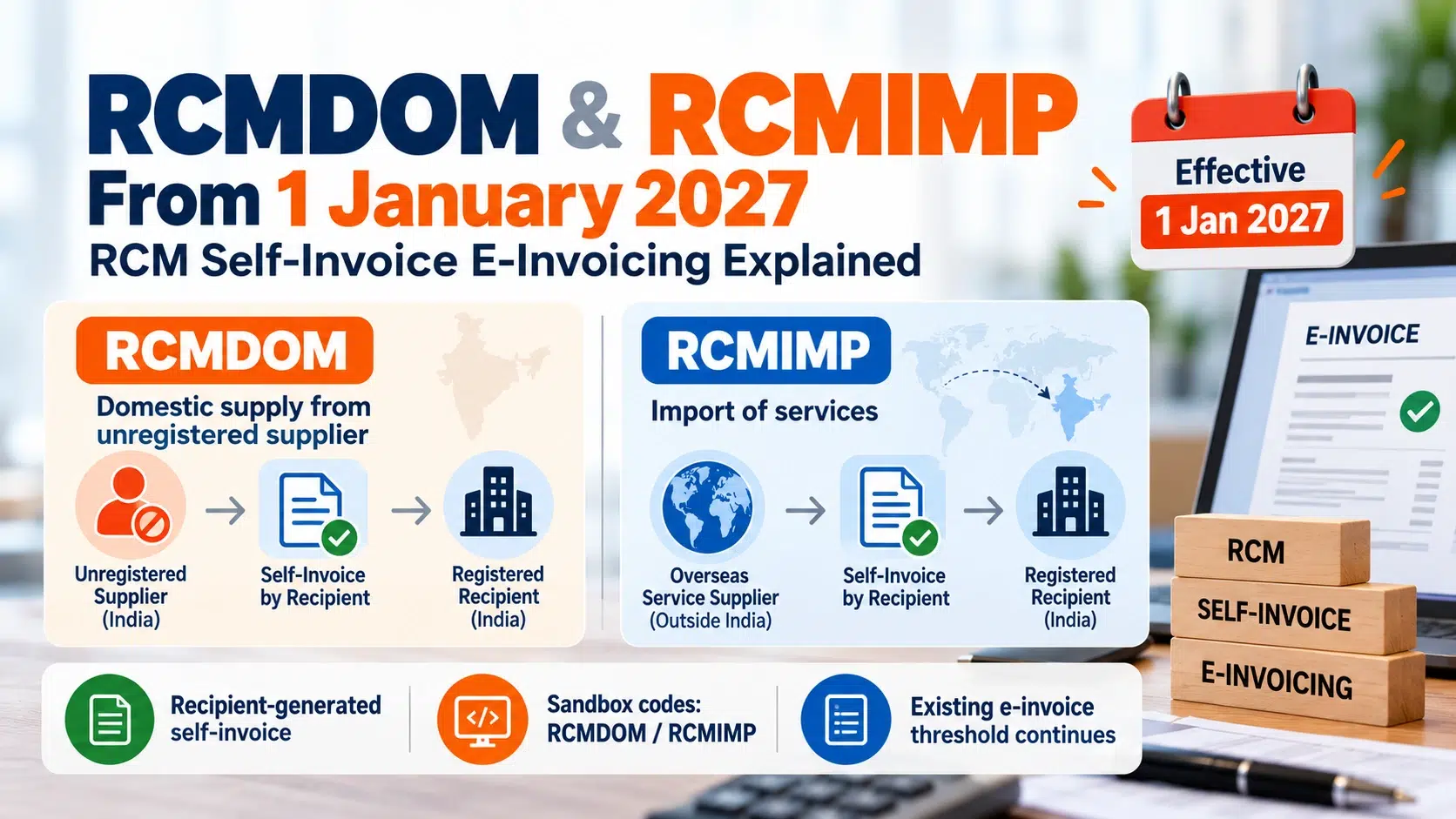
From 1 January 2027, GST e-invoicing is being extended to two additional transaction types for taxpayers already covered by the e-invoice mandate: specified domestic supplies received from unregistered persons where tax is payable under reverse charge, and import of services.
The revised e-invoice schema introduces two supply-type codes for these recipient-generated self-invoices: RCMDOM and RCMIMP.
Current Status: Legal Date Notified, Production Readiness Still to Be Watched
Legal commencement: Notification No. 04/2026-Central Tax makes the expanded e-invoicing scope effective from 1 January 2027.
System implementation: GSTN has already opened RCMDOM and RCMIMP in the sandbox environments of authorised IRPs for testing. Businesses should continue to monitor GSTN/NIC/IRP production-enablement announcements and final production validations before go-live.
Quick Answer
RCMDOM is the e-invoice supply type for a recipient-generated self-invoice relating to a domestic supply received from an unregistered person where the recipient is liable to pay GST under RCM.
RCMIMP is the supply type for a recipient-generated self-invoice relating to import of services.
Who is affected? Taxpayers in the existing e-invoice class – currently registered persons whose aggregate turnover has exceeded ₹5 crore in any preceding financial year from 2017-18 onwards, subject to the existing exclusions under the e-invoice notification.
1. What Changes from 1 January 2027?
Notification No. 04/2026-Central Tax, dated 26 October 2026, amends the principal e-invoicing notification issued under Rule 48(4). From 1 January 2027, the covered transaction descriptions expressly include:
- supplies received from an unregistered person where the recipient is liable to pay tax under reverse charge; and
- import of services.
This does not replace the existing B2B and export e-invoicing framework. It expands the transaction types that a taxpayer already falling within the e-invoice class may have to report through an Invoice Registration Portal.
Broader update: 57th GST Council Changes 2026: effective dates, circulars and notifications
2. RCMDOM and RCMIMP: What Is the Difference?
| Supply type | When it applies / what the recipient does |
|---|---|
| RCMDOM | For a covered domestic supply received from an unregistered person where the registered recipient is liable to pay GST under RCM. The recipient creates the required self-invoice and reports it using the RCMDOM supply type. |
| RCMIMP | For import of services. The Indian recipient creates the recipient-side self-invoice and reports the transaction using the RCMIMP supply type. |
3. Who Is Covered? The Existing E-Invoice Threshold Continues
Notification 04/2026-Central Tax expands the transaction scope; it does not create a new turnover threshold.
The existing e-invoice threshold continues to apply. Notification No. 10/2023-Central Tax reduced that threshold to registered persons whose aggregate turnover has exceeded ₹5 crore in any preceding financial year from 2017-18 onwards.
Existing exclusions under the principal e-invoice notification also continue unless separately amended. Therefore, the correct compliance question is not simply “Is the business GST-registered?” It is: Is this GSTIN/PAN within the notified e-invoice class, and is the transaction one of the newly covered RCM self-invoice categories?
4. The Self-Invoice Obligation Is Not New – Electronic Reporting Is
Section 31(3)(f) already requires a registered recipient liable under the specified reverse-charge provisions to issue an invoice for supplies received from an unregistered supplier.
Rule 47A prescribes a 30-day time limit from receipt of the supply for issuing the recipient-side invoice where Section 31(3)(f) applies.
The 2027 change adds an e-invoice reporting layer for taxpayers in the notified e-invoice class. In other words, the core self-invoice obligation already exists; the new development is the requirement to report the covered self-invoice through the e-invoice system and obtain an IRN, subject to the final production workflow.
5. FORM GST INV-01 Moves to Schema Version 1.2
Notification No. 05/2026-Central Tax revises FORM GST INV-01 with effect from 1 January 2027. The schema moves from Version 1.1 to Version 1.2.
The supply-type field is expanded to include RCMDOM – domestic supply from an unregistered person under RCM – and RCMIMP – import of services.
6. How the RCMDOM / RCMIMP Workflow Is Expected to Work
- Identify the transaction: determine whether it is a covered domestic RCM purchase from an unregistered supplier or an import of services.
- Confirm e-invoice applicability: verify that the taxpayer falls within the notified e-invoice class and is not covered by an applicable exclusion.
- Create the self-invoice: issue the recipient-generated invoice in accordance with Section 31(3)(f), Rule 47A and the applicable RCM provisions.
- Select the correct supply type: RCMDOM for the covered domestic transaction or RCMIMP for import of services.
- Report through an authorised IRP: transmit the prescribed invoice particulars in the production format/API.
- Obtain the IRN: on successful validation, the IRP generates the Invoice Reference Number and the applicable e-invoice response.
- Reconcile: align the self-invoice, RCM tax liability, books, GST returns and ITC records.
7. Important Technical Points from the Sandbox Specifications
The October 2026 sandbox release gives businesses and software providers an early view of the intended technical model. Important implementation points include:
- RCMDOM and RCMIMP are distinct e-invoice supply types.
- The recipient is the party registering the self-invoice.
- For the recipient-generated flow, the recipient GSTIN is relevant to IRN-generation logic.
- RCMIMP is intended for services imported from a supplier located outside India.
- E-Way Bill generation is not relevant to the RCMIMP service-import flow.
- Business validations and API requirements should be taken from the final NIC/GSTN production specifications rather than assumed from ordinary B2B invoice logic.
8. What This Change Does Not Mean
- It does not make every GST-registered person subject to RCMDOM/RCMIMP reporting.
- It does not replace the underlying RCM taxability analysis.
- It does not mean every purchase from an unregistered person attracts RCM; the underlying supply must first be one where tax is payable by the recipient under the applicable reverse-charge provision.
- It does not remove the need to examine time of supply, tax payment, ITC eligibility and return reporting separately.
- Sandbox availability does not mean the production IRP workflow is already live today.
9. Readiness Checklist Before 1 January 2027
- Identify GSTINs that fall within the existing e-invoice class.
- Map domestic RCM transactions involving unregistered suppliers separately from normal purchases.
- Map import-of-service transactions and foreign-vendor masters.
- Review Rule 47A controls so self-invoices are created within the prescribed timeline.
- Prepare separate RCMDOM and RCMIMP document flows in ERP/accounting systems.
- Test sandbox validations and error handling where available.
- Review IRN generation, cancellation and reconciliation controls.
- Monitor GSTN/NIC/IRP production-enablement announcements before go-live.
- Ensure finance, procurement, tax and IT teams understand that the recipient is responsible for the new reporting flow.
TaxPower GST Readiness
TaxPower GST is tracking the GSTN/NIC production specifications for RCMDOM and RCMIMP. Support for the new recipient-generated e-invoice workflow will be aligned with the production functionality/API and final implementation requirements made available by GSTN/IRPs.
Frequently Asked Questions
Official Reference Framework
- Notification No. 04/2026-Central Tax, dated 26 October 2026 – e-invoicing scope expansion, effective 1 January 2027.
- Notification No. 05/2026-Central Tax, dated 26 October 2026 – FORM GST INV-01 Version 1.2 and RCMDOM/RCMIMP supply types from 1 January 2027.
- Notification No. 10/2023-Central Tax – e-invoice threshold exceeding ₹5 crore.
- Recommendations of the 57th GST Council Meeting, 8 October 2026.
- GSTN Advisory No. 678 dated 16 October 2026 – sandbox introduction of RCMDOM and RCMIMP.
- Rule 47A of the CGST Rules – 30-day time limit for recipient-issued self-invoice where applicable.
Disclaimer: This article is for general information and professional awareness. Applicability should be determined after examining the relevant GST provisions, e-invoice notifications, taxpayer category, transaction facts and official production specifications. Obtain professional advice where necessary.
