57th GST Council Changes 2026: What Is Effective, From When, and What Taxpayers Need to Do
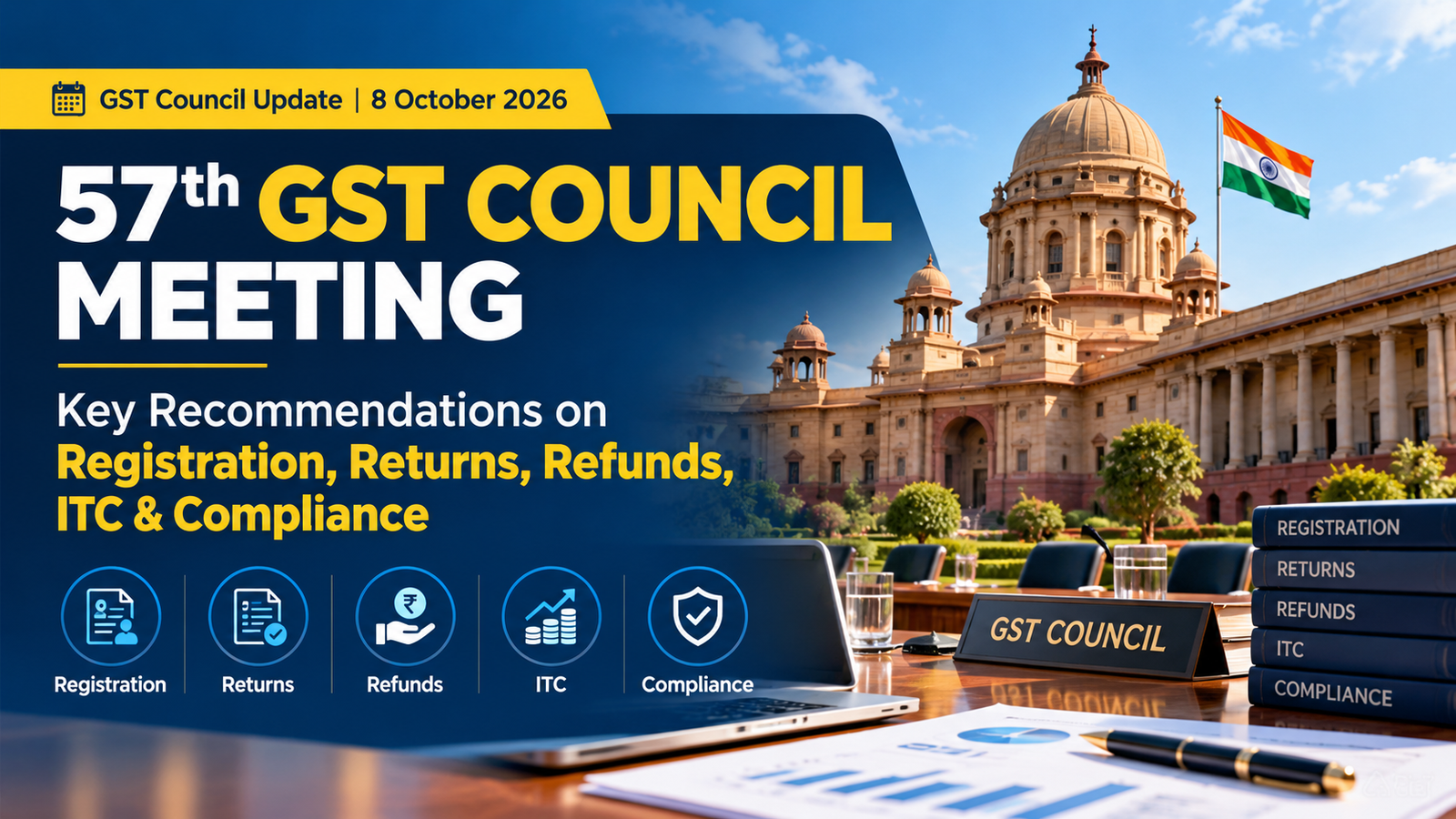
The 57th GST Council meeting held on 8 October 2026 recommended a wide-ranging set of GST reforms covering registration, returns, refunds, input tax credit, notices, adjudication, appeals, exports, e-invoicing and several sector-specific issues.
Since then, CBIC and the Government have issued circulars and notifications implementing or clarifying part of that package. This guide separates recommendations, circular clarifications, notified changes and future effective dates so that professionals and businesses can act on the correct legal status.
Important: A GST Council Recommendation Is Not Automatically Operative Law
Some Council recommendations have already been followed by notifications, amendments to the CGST Rules or CBIC circulars. Others have been notified with a future commencement date. Several major proposals still require amendments to the CGST Act or further implementation. Always check the legal instrument and its effective date before changing a tax position or compliance process.
Latest Update – 30 October 2026: CBIC Instruction 02/2026-GST
Before the recommended statutory amendments take effect, CBIC has directed its CGST field formations to implement three trade-facilitation measures on an interim basis: no further GST arrests, restricted e-way bill interception/verification, and no SCN where the amount involved is below ₹10,000.
These directions do not mean that sections 69, 68, 129, 130, 73, 74 or 74A have already been amended. They are interim operational instructions pending the recommended legislative changes.
State GST caveat: the Instruction requests circulation to State GST formations, which may, if deemed appropriate, issue similar instructions within their jurisdictions. Read the official CBIC Instruction 02/2026-GST. Detailed TaxPower guide: CBIC Instruction 02/2026-GST explained.
2. What Changes from 1 November 2026?
3. Post-Supply Discounts and Credit Notes
4. GST Refund Reforms
5. GST Registration: What Officers Can and Cannot Ask For
6. Rule 14B for Eligible E-Commerce Sellers
7. GST Notices, Adjudication and Appeals
8. ₹10,000 SCN Threshold
9. Appeal Pre-Deposit
10. Input Service Distributor
12. Export Proceeds and Rule 96(10)
13. E-Invoicing from 1 January 2027
14. Waste & Scrap: RCM, Registration and GST-TDS
15. Changes Already Notified but Effective Later
16. Interim Directions Before Full Statutory Amendment
17. Other Procedural, Rate and Sector Changes
18. Practical Checklist for GST Professionals
19. Practical Checklist for Businesses
20. Related TaxPower GST Guides
1. Status at a Glance
| Date | Change | What to note |
|---|---|---|
| 1 Dec 2026 | Revised FORM GST RFD-01 | The revised refund application and specified related form changes take effect. |
| 1 Jan 2027 | Revised e-invoice schema | INV-01 and the RCM-related supply types discussed above take effect. |
| 1 Apr 2027 | Rule 86A objection and personal hearing | Notification 05/2026-CT introduces FORM GST DRC-26, DRC-27 and DRC-28. Until then, the existing Rule 86A framework continues. |
| 1 Apr 2027 | Capital-goods refund mechanism | Rule 89 changes have deferred commencement. The Council also recommended a corresponding amendment to section 54(3), so the statutory position should continue to be monitored. |
2. What Changes from 1 November 2026?
Several immediate changes begin from 1 November 2026. They include post-supply discount and credit-note changes, a first phase of refund reforms, Rule 14B for eligible e-commerce sellers, specified waste/scrap RCM and GST-TDS changes, and other procedural amendments.
Businesses should identify the provisions that affect their own transactions instead of treating the entire Council package as one compliance event.
3. Post-Supply Discounts and Credit Notes
Notification No. 03/2026-Central Tax brings specified Finance Act, 2026 amendments into force from 1 November 2026, including changes relating to valuation, credit notes and refunds.
For post-supply discounts, the amended framework reduces the significance of the earlier statutory requirement that the discount be established under an agreement entered into at or before the time of supply and specifically linked to relevant invoices. Greater importance is placed on an appropriate credit note and reversal by the recipient of the attributable ITC, where required.
Practical action
- Review volume discounts, turnover incentives and dealer/distributor schemes.
- Review annual or quarterly rebates and credit-note procedures.
- Check recipient ITC reversal controls and reconciliation between commercial accounts and GST reporting.
4. GST Refund Reforms: Faster and More System-Based Processing
Notification No. 05/2026-Central Tax implements a substantial first phase of the refund reforms.
| Change | Practical effect |
|---|---|
| 10-day acknowledgement | Specified refund applications move from the earlier 15-day period to 10 days, with deemed acknowledgement where prescribed action is not taken in time. |
| 90% provisional refund | Qualifying claims can move toward system-based provisional sanction, subject to prescribed risk evaluation. |
| Electronic cash ledger | Eligible excess cash-ledger balances move toward more automated processing. |
| Export turnover cap | The 1.5-times restriction under Rule 89(4)(C) is removed from 1 November 2026. |
Statutory caveat for inverted duty refunds
Notification 05/2026-CT substitutes Rule 89(5) so that eligible input services are included in the Net ITC formula. The corresponding amendment to the proviso to section 54(3) should still be tracked before the expanded substantive entitlement is treated as legally settled in every case.
Related guide: GST Refund Reforms 2026
5. GST Registration: What Officers Can and Cannot Ask For
Circular No. 257/03/2026-GST, dated 26 October 2026, lays down detailed guidelines for processing GST registration applications. The objective is to reduce unnecessary documentary demands and subjective objections.
| Officer-side focus | Applicant-side action |
|---|---|
| Queries should focus on genuine deficiencies such as incomplete or illegible documents, address mismatch or other information required under the prescribed process. | Select the correct nature of possession, match the declared address with records, upload legible documents and monitor REG-03 communications. |
Related guide: GST Registration Process 2026
6. Rule 14B: Simplified Registration for Eligible E-Commerce Sellers
Eligible small suppliers selling goods through electronic commerce operators may obtain registration in a State or Union Territory where they do not have a physical presence by declaring, subject to prescribed conditions, the consenting ECO’s warehouse as the Principal Place of Business.
Eligibility: the prescribed registration and home-State conditions must be satisfied, and the ECO must consent to use of its warehouse.
7. GST Notices, Adjudication and Appeals: Stronger Procedural Discipline
Circular No. 258/04/2026-GST provides guidance on demand notices, adjudication and appeal proceedings, including quality of show-cause notices, proper invocation of fraud or suppression, principles of natural justice and reasoned orders.
Five things to check in a GST notice
- Exact issue and tax period.
- Proper quantification and factual support.
- Correct legal provisions.
- Specific factual basis for fraud or suppression allegations.
- Whether the final order deals with material submissions.
AI / automated material: independent verification and appropriate human oversight remain important where machine-generated information is used in a statutory proceeding.
Detailed guide: Circular 258 explained
8. ₹10,000 SCN Threshold: Interim CGST Direction, Statutory Amendment Pending
The Council recommended a statutory minimum threshold of ₹10,000. From 30 October 2026, CBIC Instruction No. 02/2026-GST directs CGST field formations, as an interim measure, not to issue SCNs where the amount involved is below ₹10,000.
Do not convert “below ₹10,000” into “₹10,000 or below”. SGST treatment should be checked against the relevant State instruction; the statutory amendments remain pending.
9. Appeal Pre-Deposit: Existing Clarification vs Future Recommended Cap
| Current clarification | Future recommendation |
|---|---|
| Circular 259/05/2026-GST addresses practical issues relating to pre-deposit under sections 107(6) and 112(8), including computation and refund. | The Council recommended an aggregate ceiling of ₹40 crore for penalty-only orders. Statutory amendment is still required. |
Related guide: GST Appeal Pre-Deposit and DRC-03A Explained
10. Input Service Distributor: Clarifications for Multi-GSTIN Organisations
Circular No. 260/06/2026-GST addresses practical issues concerning the ISD mechanism, especially for organisations with multiple GST registrations, common head-office expenditure and centrally received service invoices.
- Check which GSTIN receives common service invoices.
- Review ISD registration and distribution to the correct recipient GSTIN.
- Reconcile supporting invoices, distributed credit and GSTR-6 compliance.
11. Sector-Specific Clarifications: Circulars 261, 262, 265 and 266
| Area | Key point |
|---|---|
| Banks / FIs / NBFCs | Circular 261/07/2026-GST addresses issues for taxpayers opting for the mechanism under section 17(4). |
| Demo vehicles | Circular 262/08/2026-GST addresses ITC eligibility in specified demonstration-vehicle arrangements. Examine the actual business arrangement and section 17(5), rather than applying a blanket conclusion. |
| Second-hand vehicles – Circular 265 | Circular 265/11/2026-GST dated 28 October 2026 clarifies that, under the notified margin scheme, the ITC restriction applies to tax paid on the procured second-hand vehicle itself. Eligible ITC on other inputs and input services remains subject to the CGST Act. |
| Other goods – Circular 265 | The same Circular also clarifies classification/rate treatment for sublimation paper, the scope of toy entries under heading 9503, and sea-weed extract based bio-stimulants; specified past-period issues are regularised on an “as is where is” basis where stated in the Circular. |
| Specified services – Circular 266 | Circular 266/12/2026-GST dated 28 October 2026 covers R&D-grant certification, specified related-person shipping services, valuation of ancillary recoveries in motor-vehicle leasing, TRAI status, bank FTP interest and NBFC-bank co-lending. Apply the clarification relevant to the actual transaction. |
12. Export Proceeds and Rule 96(10)
| Export proceeds | Rule 96(10) |
|---|---|
| Circular 263/09/2026-GST addresses receipt of export consideration, including settlement mechanisms permitted under the applicable foreign-exchange framework. | Circular 264/10/2026-GST deals with omission of Rule 96(10) following the Supreme Court decision in Goodluck India Limited; the official Council material records 23 October 2017 as the effective date of omission. |
Historical-case caution: do not assume every old Rule 96(10) case automatically results in reopening, dropping of proceedings or fresh refund entitlement.
Detailed guide: GST Export Proceeds & Rule 96(10): Circulars 263 & 264/2026 Explained
13. E-Invoicing Expands from 1 January 2027
From 1 January 2027, the notified e-invoicing framework expands to specified domestic inward supplies from unregistered persons where the recipient is liable under reverse charge, and to import of services. It applies to registered persons already within the notified e-invoicing class.
The current notified class is based on aggregate turnover exceeding ₹5 crore in any preceding financial year, subject to notified exclusions. Revised FORM GST INV-01 includes RCMDOM for domestic RCM inward supplies and RCMIMP for import of services.
Prepare before January
- Map unregistered-vendor RCM transactions and import-of-service transactions.
- Review self-invoice or recipient-generated invoice workflows.
- Test ERP, API and IRN-generation readiness.
- Reconcile RCM liability and corresponding ITC.
Related guide: RCMDOM & RCMIMP for RCM Self-Invoices
14. Specified Waste and Scrap: RCM, Registration and 2% GST-TDS from 1 November 2026
The notified framework covers specified categories including used cooking oil, plastic waste/scrap, tyre waste/scrap and electrical/electronic waste/scrap.
| Supply pattern | Main GST point |
|---|---|
| Unregistered supplier → Registered buyer | Review RCM liability for the notified waste/scrap categories. |
| Registered supplier → Registered buyer | Review the notified 2% GST-TDS framework, including specified metal scrap under Chapters 72 to 81. |
Registration: Notification 06/2026-Central Tax modifies the registration-exemption framework for the specified categories from 1 November 2026.
Detailed guide: GST on Scrap from 1 November 2026
15. Changes Already Notified but Effective Later
| Date | Change | What to note |
|---|---|---|
| 1 Dec 2026 | Revised FORM GST RFD-01 | Revised refund application and specified related form changes take effect. |
| 1 Jan 2027 | Revised e-invoice schema | INV-01 and the RCM-related supply types take effect. |
| 1 Apr 2027 | Rule 86A objection and personal hearing | DRC-26, DRC-27 and DRC-28 framework begins; until then, the existing Rule 86A framework continues. |
| 1 Apr 2027 | Capital-goods refund mechanism | Rule 89 changes have deferred commencement and spread eligible capital-goods ITC over 60 months (broadly one-sixtieth per month); corresponding section 54(3) position should continue to be monitored. |
16. Interim Directions Before Full Statutory Amendment
- ₹10,000 SCN threshold: interim CGST direction active for amounts below ₹10,000; statutory amendment pending.
- GST arrests / section 69: CBIC directs CGST field formations that no further arrests may be carried out; statutory omission remains pending.
- E-way bill interception: interim CGST safeguards apply on intelligence, authorisation, jurisdiction and transit treatment; statutory amendments remain pending.
Still awaiting legal implementation
- ₹40 crore penalty-only pre-deposit cap.
- Wider blocked-credit relief under section 17(5).
- Late-fee relief for small taxpayers.
- Return-correction and reconciliation framework.
17. Other Procedural, Rate and Sector Changes Worth Tracking
Notification 05/2026-CT also contains changes to registration, refund, return, demand and recovery forms with staggered commencement dates. One example is revised provisional-attachment documentation under Rule 159 and FORM GST DRC-22.
The post-Council notification package also includes selected rate and classification changes involving products such as specified fertiliser/bio-stimulant products, Psyllium/Isabgol, retreaded tractor tyres and notified waste/scrap categories.
Businesses dealing in affected goods should examine the exact tariff description, HSN and notification applicable to their transaction rather than relying on a general summary.
18. Practical Checklist for GST Professionals
Immediate review
- Identify clients affected by post-supply discount and refund changes from 1 November 2026.
- Review the removal of the 1.5-times export turnover cap.
- Track the Section 54(3) position for expanded IDS refund involving input services.
- Identify scrap/waste clients affected by RCM, registration or GST-TDS.
- Review registration applications against Circular 257.
- Review SCNs and adjudication matters against Circular 258.
- Review appeal pre-deposit/refund matters against Circular 259.
- Identify exporters affected by Circulars 263 and 264.
- Identify eligible e-commerce sellers who may benefit from Rule 14B.
Do not apply prematurely
Do not treat the ₹10,000 SCN threshold or omission of Section 69 as already enacted statutory amendments. However, CBIC Instruction 02/2026-GST dated 30 October 2026 now gives interim operational directions to CGST field formations on the ₹10,000 SCN threshold, arrests and e-way bill interception. The ₹40 crore penalty-only pre-deposit ceiling, small-taxpayer late-fee waiver and wider Section 17(5) ITC eligibility remain subject to their required legal changes.
Prepare for 2027
- Before 1 January 2027: map RCM and import-of-service e-invoice workflows and test RCMDOM/RCMIMP readiness.
- Before 1 April 2027: review Rule 86A DRC-26 to DRC-28, capital-goods refund changes and other deferred form/process changes.
19. Practical Checklist for Businesses
- Giving post-sale discounts? Review credit notes and recipient ITC reversal controls.
- Claiming GST refunds? Review system-based processing, reconciliation controls and the removal of the 1.5-times export cap.
- Operating under inverted duty structure? Review the Rule 89 changes and track the corresponding Section 54(3) statutory position.
- Applying for GST registration? Follow the new document and premises guidance.
- Selling through e-commerce platforms across States? Check whether Rule 14B is relevant.
- Buying specified scrap from an unregistered supplier? Review RCM.
- Buying specified scrap from a registered supplier? Review 2% GST-TDS.
- Covered by e-invoicing? Prepare for RCM inward-supply and import-of-service reporting before January 2027.
- Moving goods under e-way bill? If a CGST field formation intercepts the conveyance, review the interim safeguards in Instruction 02/2026-GST on specific intelligence, Joint Commissioner-level authorisation, jurisdiction and transit treatment.
- Facing a GST notice? Review Circular 258. For CGST proceedings, also check Instruction 02/2026-GST: it directs that an SCN may not be issued where the amount involved is below ₹10,000. For SGST proceedings, check whether the State has issued a corresponding instruction.
- Filing an appeal? Separate Circular 259 clarifications from the proposed ₹40 crore penalty-only cap.
- Exporting? Review Circulars 263 and 264 where relevant.
20. Related TaxPower GST Guides
- RCMDOM & RCMIMP for RCM Self-Invoices
- GST Registration Process: Step-by-Step Guide, Documents and Status Check
- GST Circular 258/2026: SCN, Adjudication, Natural Justice & AI Verification
- GST Appeal Pre-Deposit & DRC-03A Explained
- CBIC Instruction 02/2026-GST: Arrests, E-Way Bill Checks and ₹10,000 SCN Threshold
- GST Export Proceeds & Rule 96(10): Circulars 263 & 264/2026
- GST Refund Filing Process Update: Invoice-Based Process
- GSTN Advisory 660: Annexure-B for Refund Applications
Frequently Asked Questions
Conclusion
The 57th GST Council meeting is best understood as a multi-stage GST reform programme, not as a single set of changes becoming effective on one date.
For every announced GST change, ask four questions: Was it only recommended? Has the relevant Act amendment, Rule, notification or circular been issued? From what date does it actually apply? What practical action is required for this taxpayer or transaction?
Act on the law that is actually in force, prepare for changes that have been validly notified for a future date, and separately track Council recommendations that still require implementation.
Managing GST Compliance for Multiple Clients?
TaxPower GST is designed for CAs, tax practitioners, GST consultants and compliance teams managing professional GST workflows. Explore TaxPower GST to understand how it can fit your practice and existing compliance process.
Official Reference Framework
- Recommendations of the 57th Meeting of the GST Council, 8 October 2026
- GSTN Advisory 676: FAQs relating to the 57th GST Council recommendations
- Official FAQs on the 57th GST Council Meeting
- CBIC Circular Nos. 257/03/2026-GST to 264/10/2026-GST dated 26 October 2026
- Notification Nos. 03/2026-CT, 04/2026-CT and 05/2026-CT dated 26 October 2026
- Notification Nos. 06/2026-CT and 07/2026-CT dated 27 October 2026
Disclaimer: This article is intended for general information and professional awareness. GST provisions should be applied after examining the relevant Act, Rules, notifications, circulars, official FAQs and the facts of the particular transaction or proceeding. Where necessary, obtain professional advice before taking a tax or compliance position.
