
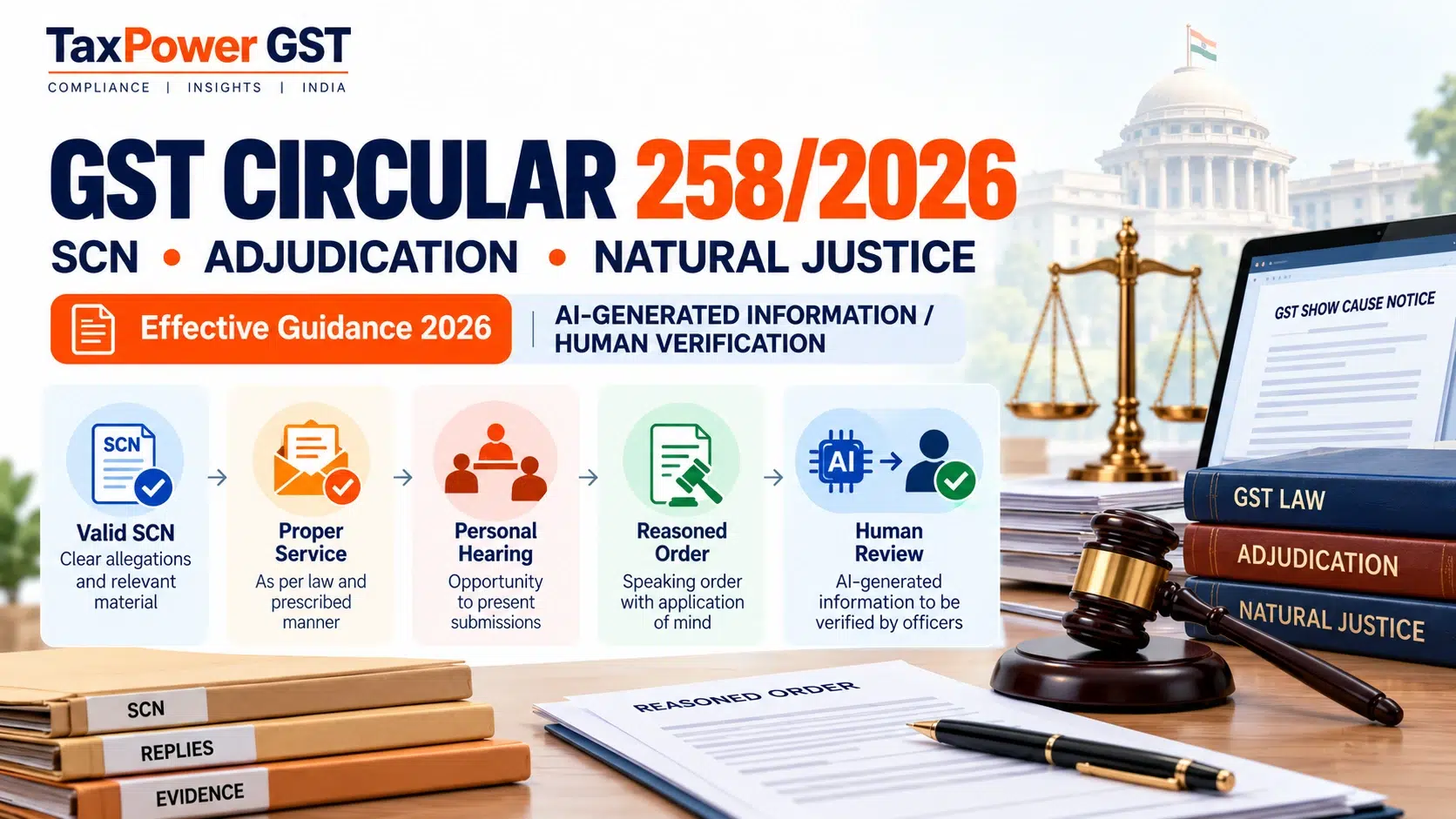
GST Circular 258/2026: SCN, Adjudication, Natural Justice and AI Verification Explained
GST Circular 258 2026, formally issued as CBIC Circular No. 258/04/2026-GST dated 26 October 2026, lays down a detailed framework for GST demand notices, adjudication, rectification and first appeals. Its central message is simple: a show cause notice must state a clear case, an adjudication order must answer the taxpayer’s case with reasons, and quasi-judicial decisions cannot be based on vague allegations, mechanical conclusions or unverified material.
The circular is particularly important for businesses, CAs and tax professionals handling GST notices because it consolidates practical safeguards relating to fraud/suppression allegations, personal hearings, speaking orders, parallel proceedings and the use of AI-generated information.
Important Status Note
Circular 258 is an administrative clarification/guideline issued under section 168(1). It does not replace the CGST Act, Rules or binding judicial precedents.
The circular itself states that its guidelines are illustrative and non-exhaustive. It also says they are not to be cited by proper officers in show cause notices, final adjudication orders or appellate orders.
Latest Update – 30 October 2026: ₹10,000 SCN Interim Direction
Circular 258 itself did not make the proposed ₹10,000 threshold operative. However, CBIC subsequently issued Instruction No. 02/2026-GST dated 30 October 2026. As an interim trade-facilitation measure pending legislative amendment, it directs CGST field formations that show cause notices may not be issued where the amount involved is below ₹10,000, taking the sum of amounts under CGST, SGST/UTGST, IGST and Compensation Cess.
Legal status: the statutory amendments to sections 73, 74 and 74A are still pending. This is an interim CBIC instruction for Central GST field formations until the recommended amendments come into force.
State GST: the Instruction was sent to the GST Council Secretariat for circulation to State GST formations, which may, if deemed appropriate, issue similar instructions within their jurisdictions. Corresponding State-level instructions should therefore be checked before assuming identical treatment by every SGST authority.
Quick Answer
- A GST SCN should set out the material facts, evidence, legal basis and quantified demand clearly.
- Fraud, wilful misstatement or suppression cannot be invoked mechanically merely because tax is unpaid or a scrutiny discrepancy exists.
- A taxpayer must get a meaningful opportunity of hearing where requested or where an adverse decision is contemplated.
- The final order must be a speaking order that deals with the reply, evidence and case law and cannot travel beyond the SCN.
- Information obtained from AI or technological tools must be independently verified; the issuing authority remains responsible for the correctness of the order.
1. Why GST Circular 258 2026 Matters
Demand and adjudication proceedings are quasi-judicial. The taxpayer must know the exact case being made, get a fair opportunity to respond, and receive an order that explains why the authority accepts or rejects the submissions.
Circular 258 brings these expectations together for officers handling notices, adjudication and first appeals. The 57th GST Council had specifically recommended common standards for GST notices and proceedings to reduce avoidable disputes and litigation.
Related series: 57th GST Council Changes 2026: What Is Effective and From When
2. Before the SCN: DRC-01A Intimation Where Feasible
Rule 142(1A) provides for pre-notice communication in Part A of FORM GST DRC-01A for demands under sections 73, 74 or 74A. Circular 258 says that such intimation should be used wherever feasible so that the taxpayer gets an opportunity to clarify the issue or make payment before a formal SCN is issued.
This stage should not be treated casually. A focused response to DRC-01A can help put the factual and legal position on record before the dispute hardens into a formal notice.
3. What a Proper GST Show Cause Notice Should Contain
The SCN is the foundational document of the proceeding. It should enable the taxpayer to understand the case and answer it effectively.
- correct identification of the taxpayer and relevant period;
- material facts and the sequence of events;
- the evidence/material relied upon;
- the statutory provisions alleged to have been contravened;
- the legal basis of the proposed demand;
- clear quantification of tax, interest and penalty, as applicable, with the basis of computation and financial-year-wise segregation where the notice covers more than one financial year; and
- reasonable time and the prescribed manner for reply.
The summary of the notice is required to be uploaded in the prescribed DRC form. Circular 258 refers, among other authorities, to Nice Enterprises v. Deputy Commissioner ST and the Supreme Court decision in G.R. Infra Project Ltd. v. State of Madhya Pradesh to reinforce that the notice itself must disclose the factual and legal foundation of the proposed action. A defective or vague SCN should not be treated as something that can simply be repaired later through reasoning in the final order.
4. Fraud, Wilful Misstatement or Suppression Cannot Be Invoked Mechanically
One of the most important parts of Circular 258 is its treatment of the extended/fraud route. Merely using the words “fraud”, “wilful misstatement” or “suppression” is not enough.
- The SCN should state the specific facts and material relied upon to allege intent to evade tax.
- Section 74 or the fraud limb of section 74A should not be invoked merely because tax remains unpaid.
- A scrutiny discrepancy by itself does not automatically establish fraud or suppression.
- Where fraud and non-fraud components coexist, the basis and quantification should be separated appropriately.
- For subsequent periods involving the same disclosed facts, a fresh fraud allegation requires an independent basis; it should not be mechanically repeated.
5. Parallel Proceedings, Timely Notice and Proper Service
No parallel proceedings on the same subject matter: where proceedings have already been initiated by the State/UT GST authority on a subject matter, the corresponding Central authority should not initiate another proceeding on that same subject matter, and vice versa, subject to the statutory framework and judicial guidance.
Do not issue notices at the last moment: the circular emphasises timely issuance so that the taxpayer gets a meaningful opportunity to respond before the limitation period expires.
Proper service matters: the SCN must be served in a mode recognised by section 169 and the prescribed electronic summary should be available on the GST Portal.
6. Personal Hearing and Natural Justice
- A personal hearing is required where the taxpayer requests one in writing or where an adverse decision is contemplated under section 75(4).
- Section 75(5) permits a maximum of three adjournments for sufficient cause. Circular 258 notes that, counting the original hearing opportunity, this may result in a maximum of four hearing opportunities.
- Reasons should be recorded where an adjournment request is refused.
- An authorised representative may appear under section 116.
- Virtual hearing may be offered where appropriate.
- The date, time and persons attending the hearing should be properly recorded.
- If the adjudicating officer changes after the hearing, the successor officer should provide a fresh opportunity of hearing before deciding the matter.
The circular also says the adjudication order should preferably be communicated within one month of completion of the personal hearing. This is an administrative good-governance guideline and does not replace the statutory time limits for passing orders under sections 73, 74 or 74A. Where hearing is complete and the adjudicating officer is being transferred, the Circular also advises the outgoing officer, wherever practicable, to endeavour to pass the order before relinquishing charge.
7. What a Speaking Adjudication Order Should Contain
The final order should demonstrate that the authority has actually considered the taxpayer’s case. Generic statements such as “the reply has been considered” are not a substitute for reasoned findings.
- deal with the material submissions made in DRC-06 and at the hearing;
- record reasons for accepting, partly accepting or rejecting the taxpayer’s contentions;
- consider judicial precedents cited by the taxpayer and explain why a precedent is or is not applicable;
- remain within the amount and grounds proposed in the SCN, in line with section 75(7);
- quantify tax, interest and penalty financial-year-wise and issue-wise, and as far as possible distinctly under the relevant tax heads (CGST/SGST/IGST/UTGST), preferably in a clear tabular computation;
- adjust amounts already paid and clearly identify amounts dropped; and
- give reasons for any penalty instead of imposing it mechanically, having regard to section 126 where applicable. Note that section 126 itself does not apply where the penalty is a fixed sum or a fixed percentage.
The summary of the adjudication order is to be uploaded in FORM GST DRC-07.
8. AI-Generated Information Requires Independent Human Verification
Circular 258 expressly recognises the use of artificial intelligence and other technological tools in tax administration. But it draws a clear accountability line.
Information generated through AI or other technological tools must be independently verified before it is relied upon.
The responsibility for the correctness of the notice/order remains with the issuing authority. AI output, automated research or machine-generated reasoning cannot replace the officer’s duty to verify facts, law, cited authorities and the taxpayer’s submissions.
9. Rectification and First Appeal: What Circular 258 Clarifies
Rectification under section 161 is confined to errors apparent on the face of the record. It is not a substitute for an appeal and should not be used to re-appreciate evidence, reopen disputed findings or correct a debatable error of law.
- A person affected by the order may bring the apparent error to the notice of the issuing authority within three months from the date of issue of the document or order.
- The rectification is ordinarily subject to the six-month outer limit in section 161. That six-month limit does not apply to correction of purely clerical or arithmetical errors arising from accidental slips or omissions.
- Rectification is to be done by the authority that issued the original document or order; Circular 258 does not treat section 5(2) as permitting a superior officer to rectify another officer’s order.
- The rectification order is to be reflected through FORM GST DRC-08, as applicable.
- Where the dispute concerns a finding on facts or law rather than an apparent error, the taxpayer should not allow the section 107 appeal limitation to expire while waiting for rectification.
For first appeals under section 107, preliminary scrutiny should focus on maintainability matters such as the prescribed form, pre-deposit, limitation and jurisdiction. The merits of the dispute should ordinarily be examined during appellate adjudication, not used to reject the appeal at the filing stage.
Where an appeal is beyond the statutory condonable period, limitation is to be decided first with reasons. Additional grounds and evidence are governed by the statutory conditions. The appellate proceeding should not be converted into a fresh investigation merely to cure defects in the original adjudication.
Cross-appeals: Circular 258 para 15.8 uses this expression for separate appeals by the taxpayer and the Department against the same impugned order and says they should be processed together and disposed of through a common composite order. This should not be confused with the memorandum of cross-objections mechanism before the Appellate Tribunal under section 112(5).
Separate topic: Circular 259/05/2026-GST deals specifically with GST appeal pre-deposit and refund issues. We are treating that separately so the two circulars are not mixed.
10. Practical Checklist for Taxpayers and GST Professionals
When You Receive an SCN
- Identify the exact section, period, issue and amount proposed.
- Check whether DRC-01/DRC-02 summary is available as applicable.
- List every document/evidence relied upon in the notice.
- If fraud/suppression is alleged, identify the specific facts said to establish intent.
- Check for parallel CGST/SGST proceedings on the same subject matter.
- File a point-wise reply with supporting documents and judicial precedents.
- Request a personal hearing in writing where appropriate.
When You Receive the Order
- Check whether each material submission has been answered with reasons.
- Check whether the order travels beyond the SCN in amount or grounds.
- Verify issue-wise/year-wise tax, interest and penalty calculations.
- Check whether cited case law has been considered.
- If the order relies on machine/AI-generated material, examine whether the underlying source and reasoning were independently verified.
- Distinguish a rectifiable apparent error from an issue that requires appeal.
TaxPower GST Editorial Note
TaxPower GST is a GST compliance platform and this article is published as a professional-awareness resource. A notice, adjudication order or appeal should be reviewed on its own facts, records and applicable law. TaxPower GST does not replace professional legal or tax advice in litigation matters.
Frequently Asked Questions
Official Reference Framework
- CBIC Circular No. 258/04/2026-GST dated 26 October 2026 – demand, adjudication and appeal proceedings.
- CBIC Instruction No. 02/2026-GST dated 30 October 2026 – interim implementation of the ₹10,000 SCN threshold for CGST field formations, along with arrest and e-way bill measures.
- CGST Act provisions including sections 6, 73, 74, 74A, 75, 107, 116, 126, 161, 168 and 169, as applicable.
- CGST Rules including rules 100, 108, 109C, 112, 113 and 142, as applicable.
- Recommendations of the 57th GST Council Meeting, 8 October 2026.
- TaxPower GST 57th GST Council Master Hub.
Disclaimer: This article is for general information and professional awareness. Demand, adjudication and appeal matters depend on the facts, records, statutory provisions and judicial precedents applicable to the case. Verify the current law and obtain professional advice where necessary.
