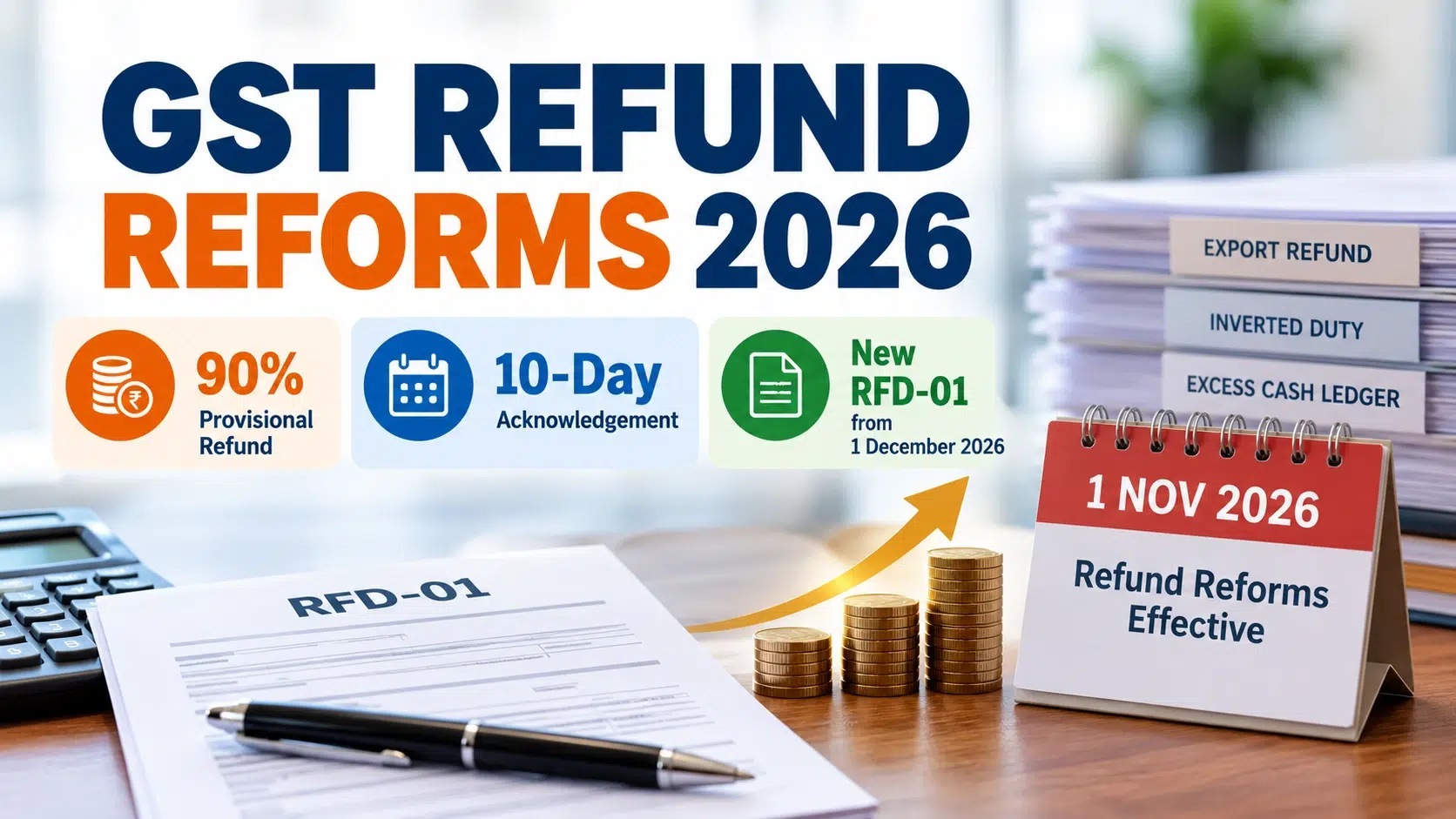
GST Refund Reforms 2026: 90% Provisional Refund, 10-Day Acknowledgement and New RFD-01
From 1 November 2026, the GST refund reforms 2026 begin under the CGST Act and the Central Goods and Services Tax (Amendment) Rules, 2026. The reforms shorten the acknowledgement stage, introduce more system-driven provisional refunds and change important refund calculations.
A second set of changes follows from 1 December 2026 through the revised FORM GST RFD-01, while capital-goods refund provisions are scheduled for 1 April 2027. The dates and legal status should therefore be tracked separately.
Quick Answer
From 1 November 2026: refund acknowledgement/deficiency timeline reduces to 10 days; deemed acknowledgement applies if no action is taken; low-risk zero-rated and inverted-duty claims move to system-generated 90% provisional refund; excess cash-ledger refunds become more system-driven; the 1.5-times export-turnover cap is removed; and Rule 89(5) expands Net ITC to include eligible input services availed on or after that date.
From 1 December 2026: the revised FORM GST RFD-01 and specified supporting-document/form changes take effect. Capital-goods refund provisions have a later commencement date of 1 April 2027.
In this guide
1. GST Refund Reform Timeline at a Glance
| Effective date | Key refund change |
|---|---|
| 1 Nov 2026 | 10-day acknowledgement/deficiency period and deemed acknowledgement under Rule 90. |
| 1 Nov 2026 | System-generated provisional refund mechanism under Rule 91 for qualifying low-risk zero-rated and inverted-duty claims. |
| 1 Nov 2026 | Portal-generated refund order framework for eligible excess electronic cash-ledger balances under Rule 92. |
| 1 Nov 2026 | Removal of 1.5-times domestic-value cap from Rule 89(4)(C). |
| 1 Nov 2026 | Eligible input services availed on/after this date included in Rule 89(5) Net ITC for qualifying inverted-duty claims, subject to the statutory caveat discussed below. |
| 1 Dec 2026 | Revised FORM GST RFD-01 and specified supporting-document/form changes. |
| 1 Apr 2027 | Specified capital-goods ITC refund provisions and 60-month attribution mechanism commence, with the statutory position still requiring careful tracking. |
2. Acknowledgement Timeline Reduces from 15 Days to 10 Days
Amended Rule 90 reduces the time available for initial scrutiny of a refund application from 15 days to 10 days.
Within that period, the proper officer should either make the acknowledgement available in FORM GST RFD-02 or communicate deficiencies in FORM GST RFD-03.
If neither happens within 10 days of filing, the application is deemed acknowledged and RFD-02 is to be made available electronically through the common portal. The Section 54(7) processing timeline is then counted from the original filing date.
3. 90% Provisional Refund Becomes More System-Driven
Section 54(6), as amended by the Finance Act, 2026 and brought into force from 1 November 2026, extends the provisional-refund framework to eligible inverted-duty structure claims in addition to the existing zero-rated supply framework.
Under amended Rule 91, the common portal is to generate FORM GST RFD-04 on the basis of system identification and risk evaluation within three working days from acknowledgement. The system-generated provisional refund order does not require revalidation by the proper officer.
The official refund FAQ explains that this automated provisional route applies to low-risk refund claims relating to zero-rated supplies and inverted duty structure. It should therefore not be read as an unconditional 90% payout for every refund application.
What happens after provisional refund?
For inverted-duty claims, final scrutiny and the final refund order continue to involve the proper officer. The system-based 90% provisional stage does not replace the final eligibility review.
4. Excess Electronic Cash-Ledger Refunds Move Toward Automatic Sanction
New Rule 92 provisions enable the common portal to generate FORM GST RFD-06 for eligible refund of balance in the electronic cash ledger under Section 49(6), after adjusting outstanding demand under the GST law or other applicable law.
This is an important working-capital reform because routine cash-ledger refunds can move through a more system-driven route rather than depend entirely on officer processing.
5. Export Refund Formula: 1.5-Times Domestic-Value Cap Removed
Rule 89(4)(C) previously capped the turnover of zero-rated supply of goods used in the refund formula by reference to 1.5 times the value of like goods supplied domestically by the same or a similarly placed supplier.
Notification 05/2026-Central Tax removes that specific cap from 1 November 2026. Exporters should still apply the remaining eligibility, valuation and documentary requirements relevant to the refund claim.
6. Inverted-Duty Refund: Eligible Input Services Enter the Rule 89(5) Formula
Notification 05/2026-Central Tax substitutes Rule 89(5). Under the amended Rule, Net ITC includes ITC availed on inputs and eligible input services during the relevant period, along with capital-goods ITC attributable to the relevant period when the deferred capital-goods provisions commence.
For this purpose, eligible input services are input services on which ITC is availed on or after 1 November 2026.
However, this does not mean that a taxpayer becomes eligible for inverted-duty refund merely because input services are taxed at a higher rate than output supplies. The official FAQ states that inversion continues to be tested by comparing the tax rate on inputs with the tax rate on output supplies.
Important Legal Caveat on Input-Service Refunds
The Rule 89(5) amendment is notified from 1 November 2026, and the official GST Council FAQ describes the intended inclusion of eligible input-service ITC in the refund formula. At the same time, the wording of clause (ii) of the first proviso to Section 54(3) continues to refer to accumulation arising from the rate of tax on inputs being higher than the rate on output supplies. The statutory position should therefore continue to be tracked before treating the expanded substantive entitlement as free from legal interpretative risk in every case.
7. Revised FORM GST RFD-01 Applies from 1 December 2026
The substituted FORM GST RFD-01 and specified related document/form changes take effect from 1 December 2026.
The broader reform direction is to capture refund information in a more structured and system-readable manner for zero-rated and inverted-duty claims, reducing dependence on scanned-document processing and allowing stronger system validation.
Refund professionals should therefore avoid assuming that the current RFD-01 preparation workflow will remain unchanged after 1 December. The GST Portal implementation and the revised statement/document requirements should be reviewed before filing claims under the new form.
Related guide: GST Refund Filing Process Update: Invoice-Based Process 2025
Related advisory: GSTN Advisory 660: Annexure-B for Refund Applications involving Accumulated ITC
8. Capital-Goods ITC Refund Provisions: Effective 1 April 2027
The amended Rule 89 framework introduces a later commencement date for capital-goods ITC. For qualifying zero-rated and inverted-duty refund calculations, eligible capital-goods ITC is to be attributed over a 60-month period, broadly one-sixtieth for each relevant month.
Only eligible ITC is relevant. Blocked credit and required reversals remain outside the refund computation.
As with input-service refunds under inverted duty structure, the corresponding statutory position under Section 54(3) should continue to be monitored before the expanded entitlement is treated as fully settled.
9. ₹1,000 Minimum Refund Restriction: Export-of-Goods Exception
Section 54(14), as amended by the Finance Act, 2026 and effective from 1 November 2026, carves out refund of tax claimed on goods exported out of India with payment of tax from the normal ₹1,000 minimum-refund restriction.
This point should be distinguished from wider Council discussions about how the ₹1,000 threshold is computed across tax heads. The operative statutory wording applicable to the particular refund category should be checked before filing.
10. What the Refund Reforms Do Not Change
- A refund claim still has to satisfy the underlying statutory eligibility conditions.
- Deemed acknowledgement is not deemed sanction of the refund.
- Low-risk classification is a system/risk-evaluation matter; the taxpayer does not self-select the automated route.
- Blocked or otherwise ineligible ITC does not become refundable merely because the formula changes.
- The existence of inverted duty structure is still based on the rate of tax on inputs versus output supplies.
- Final scrutiny continues where required, particularly for inverted-duty claims after provisional refund.
- Existing limitation, return-filing, reconciliation and documentary requirements continue unless specifically amended.
11. Practical Checklist for GST Professionals and Businesses
- Identify refund claims likely to be filed on or after 1 November 2026.
- Separate zero-rated, inverted-duty and excess-cash-ledger refund workflows.
- Ensure supporting data is complete before the 10-day acknowledgement/deficiency stage.
- Do not treat 90% provisional refund as automatic for every application; risk classification and statutory conditions still matter.
- For exporters, revisit Rule 89(4) calculations after removal of the 1.5-times cap.
- For inverted-duty clients, separately track input-service ITC availed on or after 1 November 2026.
- Review the Section 54(3) legal position before taking an aggressive refund position based only on the amended Rule formula.
- Prepare for revised RFD-01 and supporting statements from 1 December 2026.
- From 1 April 2027, maintain asset-wise/month-wise capital-goods ITC data if relevant to refund claims.
- Continue reconciling refund data with books, returns, GSTR-2B, export/SEZ records and electronic ledgers.
Frequently Asked Questions
Official Reference Framework
- Recommendations of the 57th Meeting of the GST Council, 8 October 2026
- Official FAQs on GST refund process reforms
- Official FAQs on refund of ITC on input services and capital goods
- Notification No. 03/2026-Central Tax, dated 26 October 2026
- Notification No. 05/2026-Central Tax, dated 26 October 2026 – Central Goods and Services Tax (Amendment) Rules, 2026
- Gazette ID: CG-DL-E-27102026-277451
- TaxPower GST Master Hub: 57th GST Council Changes 2026
Disclaimer: This article is for general information and professional awareness. GST refund eligibility and computation should be determined after examining the applicable Act, Rules, notifications, forms, official FAQs and the facts of the particular claim. Obtain professional advice where necessary.
