GST on Scrap from 1 November 2026: RCM, Registration and 2% TDS Explained
From 1 November 2026, the new GST scrap RCM and TDS framework applies to specified waste and scrap transactions. The practical treatment depends first on one basic question: is the supplier registered or unregistered?
That distinction determines whether the registered buyer must examine Reverse Charge Mechanism (RCM) or the GST TDS framework under Section 51.
Quick Answer
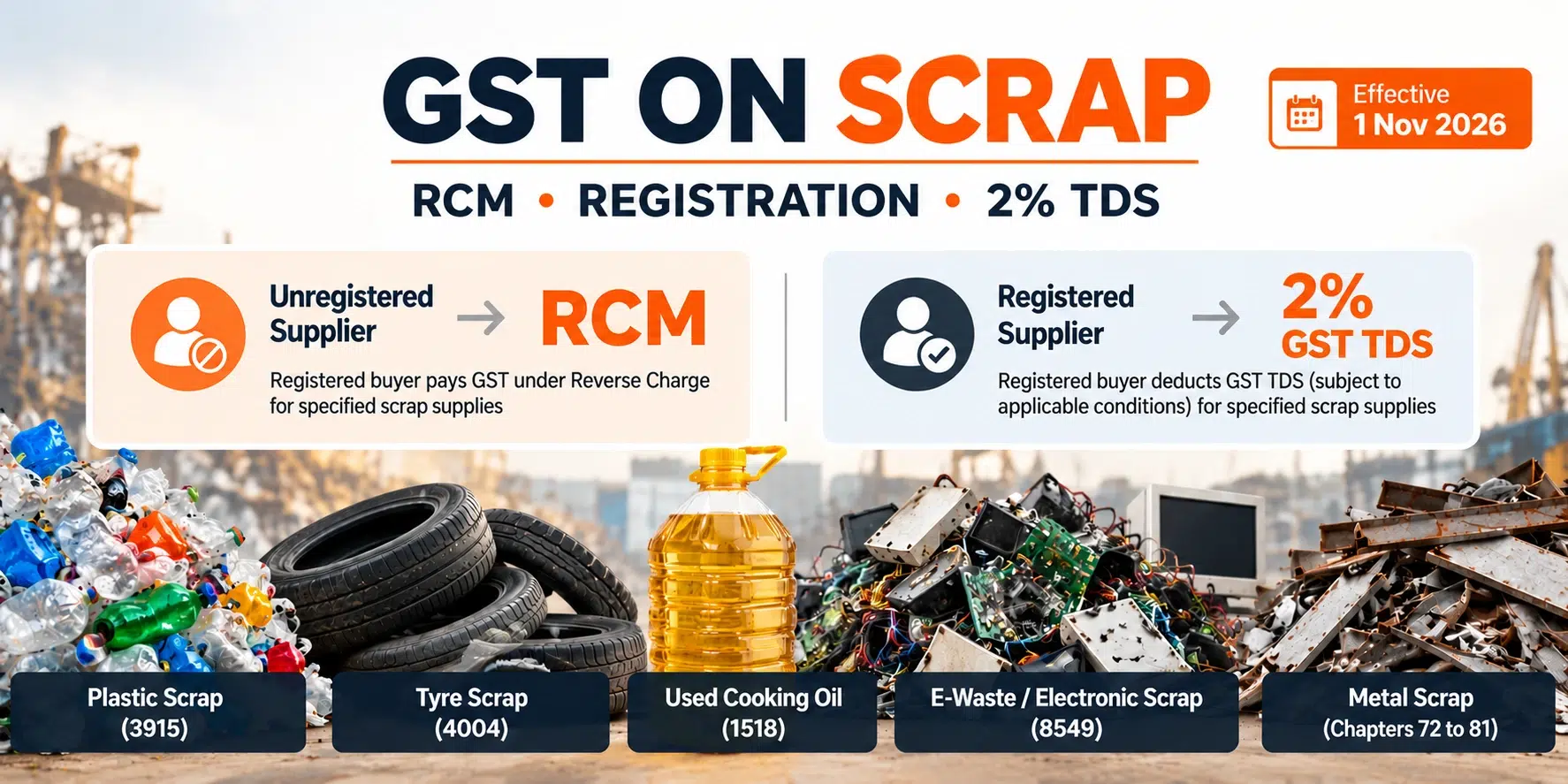
Unregistered supplier → Registered buyer: check RCM for the newly notified categories of used cooking oil, plastic waste/scrap, tyre waste/scrap and electrical/electronic waste and scrap.
Registered supplier → Registered buyer: check GST TDS at 2%, subject to Section 51 conditions including the contract-value threshold and place-of-supply proviso.
In this guide
1. Start with Supplier Registration Status
| Supplier status | What the registered buyer should do |
|---|---|
| Unregistered supplier | Check RCM – confirm that the goods fall within the notified waste/scrap category. |
| Registered supplier | Check GST TDS under Section 51 – including the contract-value threshold and place-of-supply proviso. |
The RCM and TDS pathways arise from different supplier-status situations. They should not be mixed into one generic “scrap GST” treatment.
2. Which Waste and Scrap Categories Are Covered?
The 2026 package extends the metal-scrap style RCM/TDS framework to four additional categories:
- Used cooking oil – Heading 1518
- Waste and scrap of plastics – Heading 3915
- Waste and scrap of tyres – Heading 4004
- Electrical and electronics waste and scrap – Heading 8549
Metal scrap under Chapters 72 to 81 is also included in the consolidated registration/TDS list. However, its RCM/TDS framework was introduced earlier; it is not a brand-new category from 1 November 2026.
3. GST Scrap RCM: Unregistered Supplier to Registered Buyer
Notification No. 04/2026-Central Tax (Rate), dated 27 October 2026, adds the four newly notified categories to the reverse-charge notification with effect from 1 November 2026.
The notified supplier-recipient combination is simple: any unregistered person supplying the specified goods to any registered person. The registered recipient becomes liable to pay GST under reverse charge.
This remains relevant even where the supplier is still below the registration threshold. The official GST Council FAQ expressly states that the registered buyer must discharge RCM even if the unregistered supplier has not crossed the threshold for registration.
4. Does Every Small Scrap Supplier Need GST Registration from 1 November?
No. Notification No. 06/2026-Central Tax changes the Section 23(2) registration-exemption notification so that suppliers of the five specified categories cannot continue to rely on that particular exemption once registration becomes otherwise applicable.
The official FAQ clarifies the practical position: the supplier is required to obtain GST registration when the applicable aggregate-turnover threshold under Section 22 is crossed.
So the correct reading is not “every scrap seller must register immediately.” The seller’s own registration threshold and facts still need to be examined.
Related guide: GST Registration Process: documents, premises and filing checks
Broader update: 57th GST Council Changes 2026: effective dates, circulars and notifications
2% GST TDS Does Not Apply to Every Scrap Invoice
Notification 07/2026-Central Tax brings the specified registered-to-registered supplies within the Section 51 TDS framework. The normal conditions of Section 51 still matter, including the ₹2.5 lakh contract-value threshold and the statutory place-of-supply proviso.
5. Registered Supplier to Registered Buyer: When 2% GST TDS Applies
Notification No. 07/2026-Central Tax, dated 27 October 2026, notifies a registered person receiving the specified goods from another registered person as a TDS deductor under Section 51.
The covered list is:
- used cooking oil – Heading 1518;
- plastic waste and scrap – Heading 3915;
- tyre waste and scrap – Heading 4004;
- metal scrap – Chapters 72 to 81; and
- electrical and electronics waste and scrap – Heading 8549.
The ₹2.5 lakh contract threshold
Section 51 applies where the total value of taxable supply under a contract exceeds ₹2.5 lakh. For this test, GST and cess shown on the invoice are excluded from the value.
This is therefore a contract-value test, not simply a “single invoice above ₹2.5 lakh” test.
The place-of-supply proviso also matters
Section 51 contains a specific proviso under which no deduction is to be made where the location of the supplier and the place of supply are in a State or Union Territory different from the State or Union Territory of registration of the recipient. This should be checked transaction-wise where relevant.
What does “2% TDS” mean?
The GST Council FAQ describes the total deduction as 2%. Under the normal GST TDS framework this is generally 1% CGST + 1% SGST/UTGST for an intra-State supply, or 2% IGST for an inter-State supply, subject to the applicable place-of-supply position.
Worked example: one registered-to-registered scrap purchase
Assume a notified taxable scrap item is supplied under a ₹3,00,000 contract by a registered supplier to a registered buyer in Maharashtra, with Maharashtra as the place of supply. The Section 51 deduction conditions are met. GST at 18% is assumed only to demonstrate the arithmetic; the actual GST rate must be checked against the goods’ HSN and applicable rate notification.
- Taxable invoice value (excluding GST)
- ₹3,00,000
- GST assumed @18% for this illustration
- ₹54,000
- Total supplier invoice
- ₹3,54,000
- GST-TDS @2% of ₹3,00,000
- ₹6,000
- Net payment to supplier
- ₹3,48,000
- GST-TDS remitted separately by buyer
- ₹6,000
What is happening? The supplier’s invoice includes the applicable GST. The buyer withholds ₹6,000 from the invoice payment and deposits it as GST-TDS; this is not a second 2% GST charge. The supplier accounts for its output GST in the normal returns, while the GST-TDS credit becomes available in the supplier’s electronic cash ledger after the prescribed portal reporting and acceptance.
Threshold reminder: The taxable supply value under the contract must exceed ₹2.5 lakh. Check the place-of-supply proviso, registration status and notified goods separately; this example is not a blanket rule for all scrap purchases.
RCM vs GST-TDS: who issues the invoice and which return applies?
- Unregistered supplier → Registered buyer (RCM): The registered buyer issues the self-invoice and payment voucher, pays RCM and reports the inward transaction in GSTR-3B (Table 3.1(d), where applicable). No GST-TDS or GSTR-7 arises from this unregistered-supplier purchase. The buyer’s self-invoice is not its outward sale to report in GSTR-1.
- Registered supplier → Registered buyer (GST-TDS, when Section 51 conditions apply): The registered supplier issues the normal GST tax invoice and reports its sale in GSTR-1 and GSTR-3B. The registered buyer deducts GST-TDS, deposits it and files GSTR-7. This is not an RCM self-invoice purchase.
One dealer can have both roles: A scrap trader may file GSTR-1 for its own outward sales and GSTR-7 under a separate GST-TDS deductor registration for purchases on which it is legally required to deduct tax, alongside applicable GSTR-3B compliance. These are separate transactions and filing obligations; issuing an RCM self-invoice does not by itself trigger either GSTR-1 or GSTR-7.
Legal and process references: CGST Act, Section 51 and official GST Council FAQs (57th Meeting).
6. GST Scrap RCM Documentation and Reporting for the Buyer
Where the registered buyer receives covered goods from an unregistered supplier and RCM applies, the compliance flow should include:
- Verify classification: confirm that the goods fall within the notified heading/chapter.
- Verify supplier status: confirm whether the supplier is registered on the transaction date.
- Issue the recipient-side invoice: Section 31(3)(f) requires the registered recipient liable under RCM to issue an invoice for supplies received from an unregistered supplier.
- Issue the payment voucher: Section 31(3)(g) applies when payment is made to the supplier.
- Pay and report RCM correctly: report the inward supplies liable to RCM in the appropriate GSTR-3B Table 3.1(d) and pay the RCM liability in cash. The buyer’s self-invoice for an inward purchase does not become an outward sale in its GSTR-1.
- Review ITC separately: ITC on RCM tax is subject to the normal eligibility conditions; payment under RCM does not by itself guarantee credit.
Related guide: RCMDOM & RCMIMP for RCM Self-Invoices and the January 2027 e-invoicing change
7. What Registered Buyers Should Review for GST TDS
- where GST-TDS deduction is required, whether a separate GST-TDS deductor GSTIN is already active; an existing Regular GSTIN does not replace the deductor registration;
- whether the goods fall within the notified headings/chapters;
- whether the supplier is registered;
- whether the Section 51 contract-value threshold is crossed;
- whether the place-of-supply proviso permits deduction;
- deduction and deposit of the applicable TDS;
- GSTR-7 compliance under the prescribed framework; and
- reconciliation of supplier invoices, payments and TDS credit.
Does a regular GST-registered scrap buyer need a separate GST-TDS GSTIN?
Yes, when the buyer is required to deduct GST-TDS under Section 51. The buyer needs a separate GST-TDS deductor registration even if it already holds a Regular GSTIN for its business. Section 24(vi) covers persons required to deduct GST-TDS, and Rule 12 prescribes FORM GST REG-07 for deductor registration. This means an additional GSTIN for deductor compliance, not a second business entity.
| GST registration | What it is used for | Relevant returns |
|---|---|---|
| Regular GSTIN Normal taxpayer registration |
Own outward taxable supplies, regular GST compliance and eligible inward purchases liable to RCM. | GSTR-1 and GSTR-3B, as applicable. Inward RCM purchases are reported in GSTR-3B, not as the buyer’s sales in GSTR-1. |
| Separate GST-TDS GSTIN Tax deductor registration under Rule 12 / REG-07 |
Deduction and reporting of GST-TDS when notified purchases from registered suppliers meet the conditions of Section 51. | GSTR-7 and the prescribed GST-TDS payment/reporting process. |
Important distinction: Do not seek a new GST-TDS registration simply because a dealer buys scrap. Confirm that the goods and transaction attract TDS, including the contract-value threshold of more than ₹2.5 lakh and the applicable place-of-supply proviso. If a suitable GST-TDS registration is already active, do not apply again merely for another purchase. Buying from an unregistered supplier under RCM does not by itself create a GST-TDS registration obligation.
Official basis: CBIC registration FAQ, Question 19 confirms that a registered person requires separate registration as tax deductor; CGST Rule 12 prescribes the REG-07 application.
GSTN Advisory 684: GST-TDS registration through REG-07
Where a registered buyer is required to deduct GST-TDS on the notified goods and needs GST-TDS registration, the application is made on the GST Portal through FORM GST REG-07. The GSTN Advisory dated 1 November 2026 directs the applicant to select “Others” under “Constitution of Business” in Part B, Table 2. This opens a mandatory text field for the relevant dealer category. This is a GST-TDS deductor registration step, not the supplier’s ordinary GST registration application.
For the newly notified goods, GSTN gives examples such as “Used Cooking Oil Dealers”, “Waste and Scrap of Plastics Dealers”, “Waste and Scrap of Tyres Dealers” and “Electrical and Electronics Waste and Scrap Dealers”. For metal scrap, the GSTN advisory dated 22 October 2024 specifically prescribed “Metal Scrap Dealers”. Enter the category applicable to your goods, complete the remaining REG-07 details and submit the application. First verify whether a valid GST-TDS registration is already available for the relevant deductor.
This is a GST-TDS registration form workflow. It does not change the separate questions of supplier registration, reverse-charge liability, Section 51 contract threshold or place-of-supply restrictions already explained above.
8. What Businesses and GST Professionals Should Review Now
- Map vendors by registered / unregistered status.
- Map the relevant HSN headings: 1518, 3915, 4004, 8549 and metal scrap Chapters 72 to 81.
- Create separate purchase workflows for RCM and registered-supplier TDS review.
- Identify contracts with registered suppliers that may cross the Section 51 threshold.
- Review recipient-side invoice and payment-voucher controls for RCM.
- Where GST-TDS registration is required, complete FORM GST REG-07 on the GST Portal using “Others” and the accurate category in Part B, Table 2; review GSTR-7 readiness.
- Do not assume one common GST rate merely because RCM applies; verify the applicable rate for the goods.
- Reconcile books, GST ledgers and vendor masters before the first affected transactions are processed.
TaxPower GST Readiness
TaxPower GST supports GST compliance workflows, but applications for GST-TDS registration through FORM GST REG-07 are made on the official GST Portal, not inside TaxPower GST. For any specific scrap RCM/TDS software workflow, confirm currently available features with the TaxPower team before relying on them. This guide is not a promise of future GSTN form or API support.
Frequently Asked Questions
Official Reference Framework
- Notification No. 04/2026-Central Tax (Rate), dated 27 October 2026
- Notification No. 06/2026-Central Tax, dated 27 October 2026
- Notification No. 07/2026-Central Tax, dated 27 October 2026
- CBIC GST Registration FAQs, Question 19: separate GST-TDS registration
- CGST Rules, Rule 12: REG-07 registration for tax deductors
- GSTN Advisory 684, dated 1 November 2026: TDS registration for scrap and other notified goods
- GSTN REG-07 Advisory, dated 22 October 2024: Metal Scrap Dealers
- Official FAQs on the 57th GST Council recommendations
- Section 51 of the CGST Act – Tax deduction at source
- Section 31 of the CGST Act – Tax invoice
- Section 22 of the CGST Act – Persons liable for registration
Disclaimer: This article is for general information and professional awareness. The applicable GST position should be determined after examining the relevant Act, Rules, notifications, tariff classification, place-of-supply provisions and facts of the transaction.
